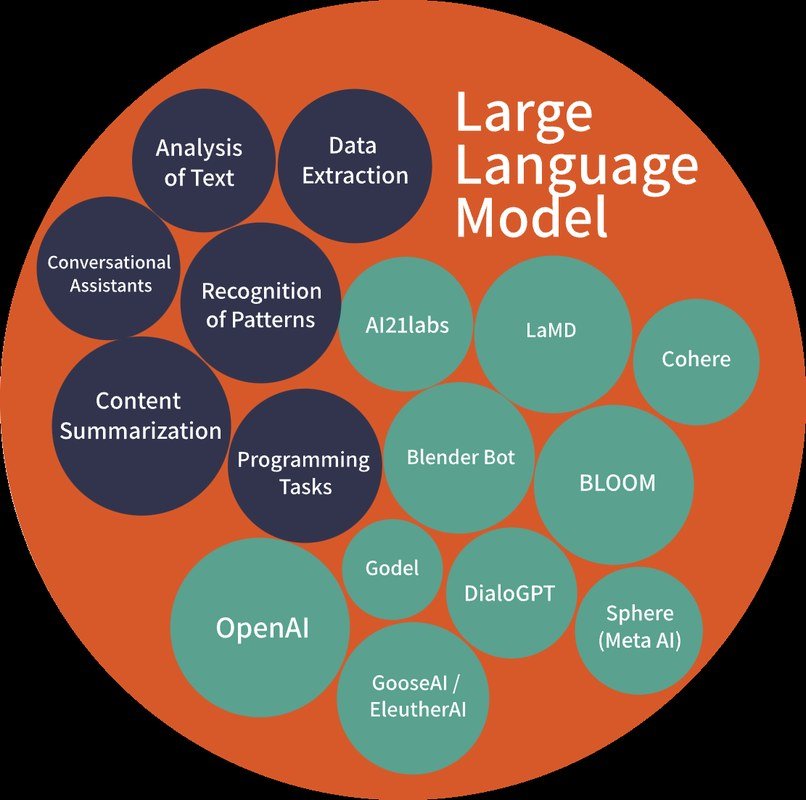
What Is Large Language Model in Simple Words Explained
A large language model is an AI trained on massive text data to predict and generate human-like language. It works by learning word patterns and producing one word at a time based on probability.
If you’ve been wondering what is large language model in simple words, here’s the short version: it’s a type of artificial intelligence trained on massive amounts of text to predict and generate human-like language. You’ve probably used one without realizing it — through a chatbot, a writing assistant, or even a search engine that finishes your sentence.
Large language models, or LLMs, have become one of the most talked-about technologies in recent years. But behind the hype, they’re not magic. They are mathematical systems that learn patterns from text and use those patterns to produce new text. This guide explains how they work, what they’re good at, where they fall short, and how to decide whether one is right for your needs.
- Definition: An LLM predicts and generates text by learning patterns from huge datasets.
- How it works: Training adjusts parameters to improve next-word predictions; inference generates text one word at a.
- Key specs: Parameter count, context window length, and multimodal abilities shape what a model can do.
- Main risks: Hallucinations, bias, and data privacy issues are the biggest concerns.
- Best use: Use LLMs for drafting, summarizing, and brainstorming, but verify important facts.
What Is a Large Language Model in Simple Words?
At its core, a large language model is a computer program that learns to understand and generate text by studying examples. It doesn’t “know” facts the way a person does. Instead, it learns statistical relationships between words: which words tend to appear together, in what order, and in what context.
A Simple Analogy: The Autocomplete on Steroids
Think about typing a text message and seeing your phone suggest the next word. That’s autocomplete. A large language model is like that, but on a much larger scale. It has read billions of sentences, so it can predict not just the next word, but entire paragraphs, emails, essays, and even code.
If you type “The weather today is,” the model doesn’t know the actual weather. It predicts what a human would likely write next: “sunny,” “rainy,” “cold,” or something similar. The more context you give it, the better its guesses become. That’s why detailed prompts usually produce better answers.
Defining “Large” and “Language” in LLMs
“Large” refers to two things: the size of the training data and the number of parameters in the model. Parameters are the internal values the model adjusts as it learns. More parameters generally mean the model can capture more complex patterns, but they also require more computing power.
“Language” means the model is built to process human language — words, sentences, and documents. Some LLMs can also process images, audio, and video, but their foundation is language. Because language is how humans express most knowledge, LLMs become useful across many tasks.
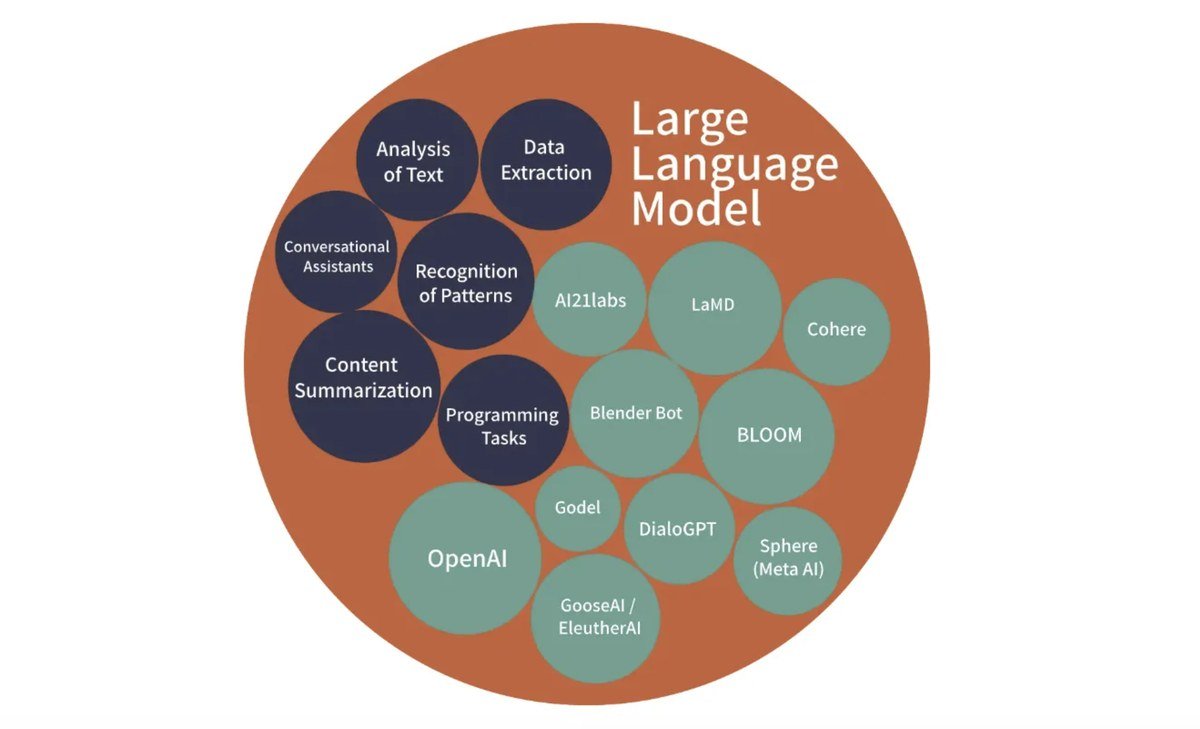
The “large” in large language model usually refers to the number of parameters, which can range from millions to hundreds of billions depending on the model.
How Do Large Language Models Actually Work?
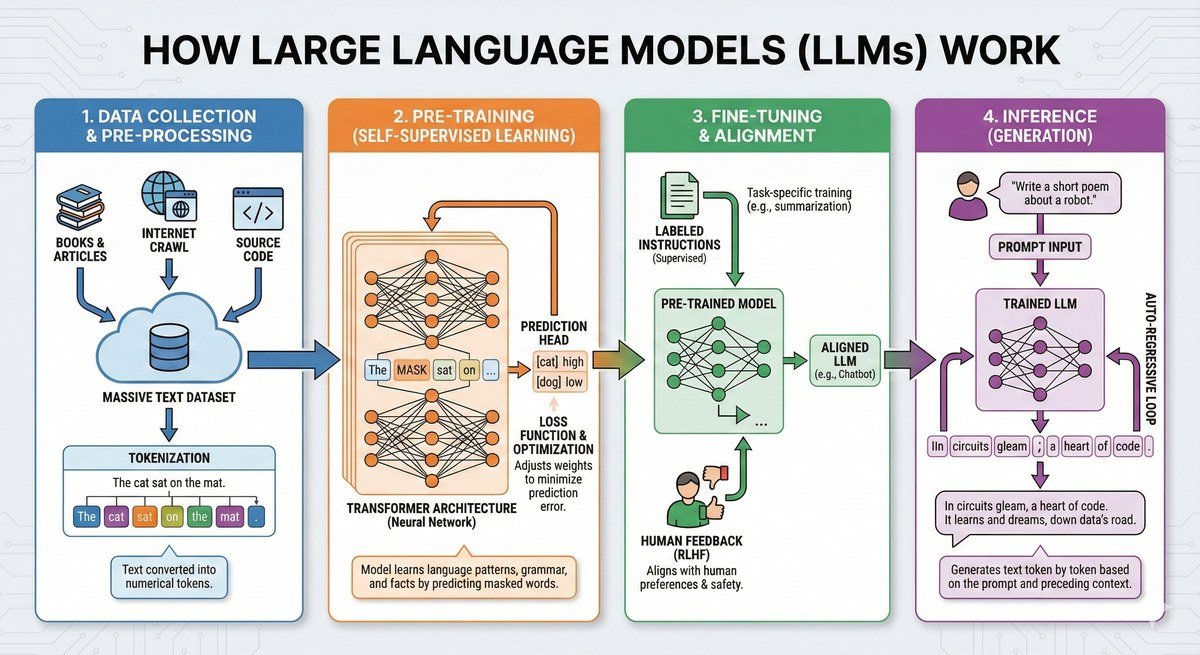
Illustration of text input flowing through neural network layers to produce output.
LLMs are a type of deep learning model, which itself is a branch of machine learning. They learn by finding patterns in enormous collections of text pulled from books, websites, articles, and public documents. This process has two main phases: training and inference.
Training on Massive Text Datasets
During training, the model is shown text one piece at a time. It tries to predict the next word, checks its answer against the actual word, and adjusts its internal parameters to reduce the error. This is repeated billions of times. Over time, the model develops a statistical “understanding” of grammar, facts, reasoning patterns, and even styles of writing.
Because the dataset is so large, the model picks up a broad range of knowledge. But it also picks up biases, misinformation, and offensive language that exist in the source material. That’s why training is only half the story; developers often add extra steps to make outputs safer and more helpful.
Predicting the Next Word with Probability
When you ask an LLM a question, it doesn’t look up an answer in a database. It generates one word at a time, choosing each word based on probability. The model calculates which word is most likely to come next given everything it has seen before and the context you provided.
This is why LLMs can produce confident-sounding but incorrect answers. They are not retrieving facts; they are generating the most plausible sequence of words. That distinction matters when you rely on them for important information.
Key Features to Look For in a Large Language Model
Not all LLMs are the same. If you’re choosing one for work, study, or creative projects, these three features matter most.
Model Size and Parameter Count
Parameter count is the most common way to compare models. A model with more parameters can usually handle more complex tasks, but it also needs more computing power and may be slower. Smaller models are often good enough for everyday writing and can run on a laptop or phone.
Context Window Length
The context window is the amount of text the model can “remember” while generating a response. A longer context window lets you paste in a long article or chat history and have the model consider all of it. If you plan to summarize reports or work with large documents, context length matters more than raw parameter count.
Context window sizes vary widely by model and version. Check the official documentation for the exact limit before assuming a model can handle your longest documents.
Multimodal and Specialized Capabilities
Many modern LLMs are multimodal, meaning they can process images, audio, or video in addition to text. Others are specialized for code, medicine, law, or customer service. A general-purpose model is a good starting point, but a specialized model may be worth considering if you have a narrow, high-stakes use case.
Who Should Use Large Language Models?<
Professionals from different fields use large language models on their computers for work tasks.
Professionals from different fields use large language models on their computers for work tasks.
LLMs are useful for anyone who works with words, information, or code. Here’s how different groups typically benefit.
Writers, Students, and Content Creators
LLMs can help with brainstorming, outlining, editing, and rewriting. Students can use them to clarify difficult concepts or get feedback on drafts. Content creators can generate ideas, headlines, and social media captions. The key is to treat the output as a starting point, not a final product.
Programmers and Data Scientists
Developers use LLMs to write code snippets, explain unfamiliar functions, debug errors, and generate documentation. Data scientists use them to clean up text data, summarize findings, and prototype ideas. For technical work, it’s still important to review every line of code the model produces.
Businesses and Customer Support Teams
Companies use LLMs to draft emails, write product descriptions, and power chatbots. Customer support teams can answer common questions faster and escalate complex issues to humans. Businesses should be careful about sharing sensitive data with public LLM services and should understand their privacy policies first.
Creative Ways to Use Large Language Models
Beyond answering questions, LLMs shine in tasks that involve generating or transforming text. These are some of the most practical uses.
Brainstorming and Drafting Ideas
Stuck on a blank page? Ask the model for ten title ideas, five opening sentences, or a rough outline. It won’t be perfect, but it can break the block and give you a structure to improve.
Summarizing Long Reports and Articles
Paste a long document into a model with a large context window and ask for a bullet-point summary. This works well for meeting notes, research papers, and news articles. Always compare the summary against the original for accuracy.
Language Translation and Personalized Learning
LLMs can translate between languages, explain idioms, and adapt their tone to a specific audience. You can ask the model to rewrite a paragraph for a child, a customer, or a board member. This makes them powerful tools for learning and communication. These creative tasks are all examples of generative AI in action.
Benefits and Limitations of Large Language Models
LLMs are powerful, but they’re not a universal solution. Here are the main trade-offs.
The Biggest Advantages: Speed, Scale, and Accessibility
LLMs can generate text in seconds, work across dozens of languages, and run on devices as small as a smartphone. They lower the barrier to writing, coding, and learning. For many tasks, they are faster and cheaper than hiring a human expert.
The Drawbacks: Bias, Hallucinations, and Ethical Concerns
LLMs sometimes produce “hallucinations” — confident, believable statements that are completely false. They can also reflect the biases in their training data, leading to unfair or harmful outputs. And because they were trained on publicly available text, there are unresolved questions about copyright, privacy, and the environmental cost of running huge models.
- Fast drafting and brainstorming for any written task
- Works across languages and domains with minimal setup
- Available through free and low-cost chat interfaces
- Can produce false or outdated information with confidence
- May reflect bias or offensive content from training data
- Privacy and copyright risks depend on the service you use
Common Mistakes When Using Large Language Models
Most problems with LLMs come from how people use them, not from the models themselves. Avoid these mistakes to get better results.
Treating Output as Absolute Truth
LLMs are not search engines. They don’t verify facts. If you ask for a statistic, a legal citation, or a medical recommendation, the model may invent one. Always fact-check important claims against a reliable source.
Ignoring Prompt Engineering and Context
Vague prompts produce vague answers. The more context you provide — the role, the audience, the format, the constraints — the better the output. A prompt like “Write a professional email to a client” is fine, but “Write a polite email to a client who missed a payment, suggesting a new due date” will get a much more useful result.
Treat the model like a smart intern: give it clear instructions, examples, and a desired format. If the first answer isn’t right, refine the prompt instead of repeating it.
Overlooking Data Privacy and Security
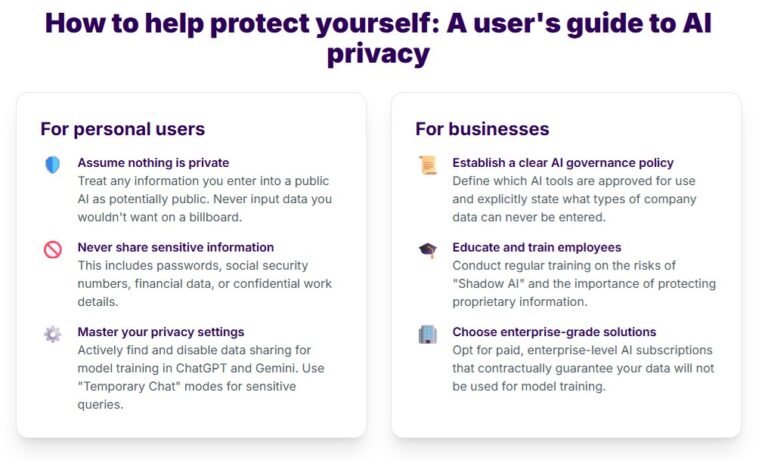
When you paste confidential documents into a public LLM, that data may be used to improve the service or stored by the provider. Check the privacy policy before sharing personal, financial, or proprietary information. For sensitive work, consider a private or self-hosted model. Before you paste anything sensitive, it’s worth understanding what data ChatGPT collects.
Never share passwords, health records, trade secrets, or personal data of others in a public chat interface. Use enterprise or local models when handling sensitive information.
Choosing the Right Large Language Model and Final Verdict
There is no single best LLM. The right choice depends on your budget, technical comfort, and the sensitivity of your data.
Open-Source vs. Commercial Models
Commercial models are easy to use, usually have the best performance, and are hosted by companies that handle the infrastructure. Open-source models give you more control, can run on your own hardware, and avoid sending data to a third party, but they require more technical skill to set up and maintain.
Alternatives to Large Language Models
Not every task needs an LLM. A standard search engine is better for finding current facts, a spreadsheet is better for calculations, and a human expert is better for high-stakes decisions. LLMs are most valuable when you need to generate, summarize, or rephrase text quickly.
Are Large Language Models Worth It? Our Recommendation
For most people, yes — but as a tool, not a replacement for judgment. Start with a free or low-cost chat interface, use it for low-risk writing tasks, and build your skills in prompt writing. If you work with sensitive data, choose a service with clear privacy protections or run a local model. The best way to decide is to try one on a real project and see whether it saves you time without creating new problems.
- Definition: An LLM is an AI trained on massive text data to predict and generate language.
- How it works: It learns word patterns during training and generates one word at a time using probability.
- Key features: Parameter count, context window, and multimodality determine what a model can do.
- Biggest risk: LLMs can hallucinate, reflect bias, and expose private data if used carelessly.
- Bottom line: Use LLMs for drafting and summarizing, but fact-check important output and protect sensitive information.
Frequently Asked Questions


One Comment