
What Is Generative AI and How Does It Work Simply Explained
Generative AI is technology that creates new content — text, images, audio, and video — by learning patterns from large datasets. Instead of just analyzing data, it predicts and builds original outputs that resemble what it was trained on.
If you want a clear, no-jargon answer to what is generative ai and how does it work, you’re in the right place. Generative AI now drafts emails, creates images, writes code, and composes music, but the technology behind it can feel like a black box. This guide explains the core ideas in plain English and gives you practical guidance on using these tools responsibly.
- Definition: Generative AI produces new content rather than simply analyzing or classifying existing data.
- How it works: Models learn patterns from training data and generate by predicting the next word, pixel.
- Main types: Transformers power chatbots and text tools; diffusion models power image and video generators.
- Limitations: Hallucinations, bias, and privacy risks mean every output needs human review.
- Getting started: Choose a free tool matched to your task, write specific prompts, and verify results.
What Is Generative AI? A Simple Definition
Generative AI is a branch of artificial intelligence that creates new content instead of simply analyzing or sorting existing content. Traditional AI models classify, label, or predict: they flag spam emails, detect faces in photos, or estimate a customer’s next purchase. Generative AI goes a step further and produces original text, images, audio, video, or code that closely resembles the data it was trained on.
A useful analogy: traditional AI is like a librarian who can organize and find books, while generative AI is like an author who has read thousands of books and can write a new one. The new book is not a copy of any single source, but it reflects the language and style the author absorbed.
The word “generative” is the key: the model produces something new — a sentence never written before, an image that never existed — rather than recognizing or retrieving what already exists.
How Does Generative AI Work Under the Hood?

A flowchart illustrating how a generative AI model turns a text prompt into an output.
The Role of Training Data in Generative Models
Everything starts with training data. A text model is trained on enormous collections of books, articles, websites, and documents. An image model is trained on millions of photos, drawings, and illustrations. During training, the model studies these examples and learns statistical patterns: which words tend to follow other words, how objects relate to one another in a scene, what realistic lighting and texture look like.
The size, quality, and diversity of the training data shape what the model can do. A model trained mostly on one type of content will struggle with anything outside that range. This is why data curation matters so much — and also why the question of who owns the training data has become a major legal battleground.
Most large language models have a training data cutoff date. They only know information up to that point unless they are connected to live search. For time-sensitive questions, check the model’s knowledge cutoff or verify with a current source.
Neural Networks and Pattern Recognition
The engine behind generative AI is a neural network, a computational system loosely inspired by the human brain. A neural network is built from layers of interconnected nodes, often called neurons. Each connection has a weight that determines how strongly one node influences another.
During training, the network learns by trial and error. It makes a guess, compares it with the correct answer, calculates the difference, and adjusts its weights to reduce that error. Repeating this process millions of times allows the network to recognize increasingly complex patterns — from individual letters to sentence structure to abstract qualities like tone and genre.
Deep learning simply means a network with many layers. The “deep” in deep learning is exactly that: more layers let the model capture more abstract patterns, which is what allows it to produce nuanced and surprisingly human-like output.
Probability, Prediction, and the Art of Generation
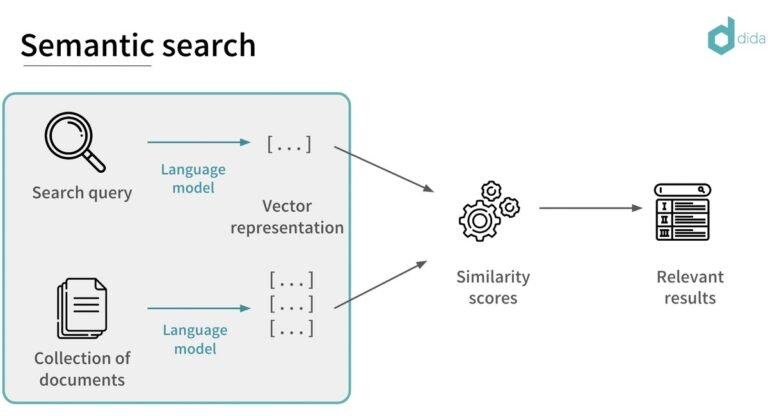
Here is the most important idea to understand: generative models do not think or decide in a human sense. They predict. A text model generates one token — a word or word fragment — at a time, calculating the probability of each possible next token based on everything it has seen so far. An image model does something similar at the pixel or patch level.
Because generation is probabilistic, it involves randomness. Models use a setting called temperature to control how random the output is. Low temperature produces predictable, safe responses; high temperature produces more varied and creative ones. This is why the same prompt can produce different results on different attempts.
The “art” of generation is really a combination of learned patterns, probability, and a touch of randomness — not consciousness, intention, or true understanding.
The Main Types of Generative AI Models
Transformers and Large Language Models
The transformer architecture, introduced in the 2017 research paper “Attention Is All You Need,” completely changed the AI landscape. Transformers use a mechanism called self-attention, which lets the model weigh the importance of every word in a sentence relative to every other word. This makes them exceptionally good at understanding context and generating coherent text.
Large language models (LLMs) — the technology behind chatbots like ChatGPT, Claude, and Gemini — are transformers trained on massive text datasets. They handle writing, summarization, translation, coding, and conversation. Many modern LLMs are multimodal, meaning they can also process images and audio, not just text.
Diffusion Models and Image Generators
Diffusion models power most modern text-to-image tools, including DALL-E, Midjourney, and Stable Diffusion. The concept is surprisingly elegant: start with a clear image, gradually add random noise until it becomes pure static, and then train the model to reverse the process. To generate a new image, the model starts with random noise and slowly removes it, guided by a text prompt, until a recognizable picture emerges.
Diffusion models are also used for video generation and audio synthesis. They tend to produce higher-quality, more diverse images than earlier approaches, which is why they quickly became the dominant method for visual content.
GANs and VAEs: The Earlier Pioneers
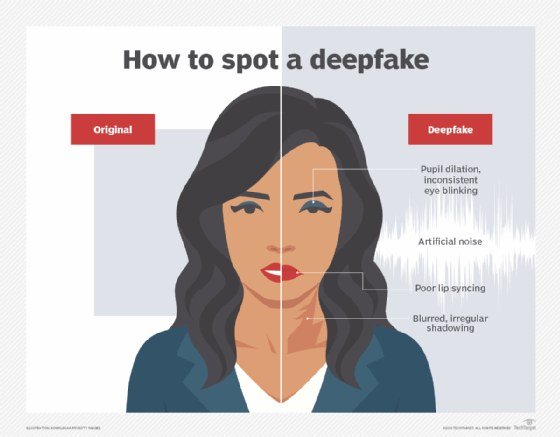
Before transformers and diffusion models, two other architectures led the field. Generative Adversarial Networks (GANs) pit two networks against each other: a generator creates fake images while a discriminator tries to spot them. This competition pushes the generator to produce increasingly realistic output. GANs powered the early deepfake face-swapping techniques.
Variational Autoencoders (VAEs) work differently. They compress input data into a compact mathematical space and then learn to reconstruct it, allowing the model to generate new examples by sampling from that space. VAEs are still used for tasks like anomaly detection and data compression.
While GANs and VAEs paved the way, most cutting-edge image generation today relies on diffusion, and most text generation relies on transformers.
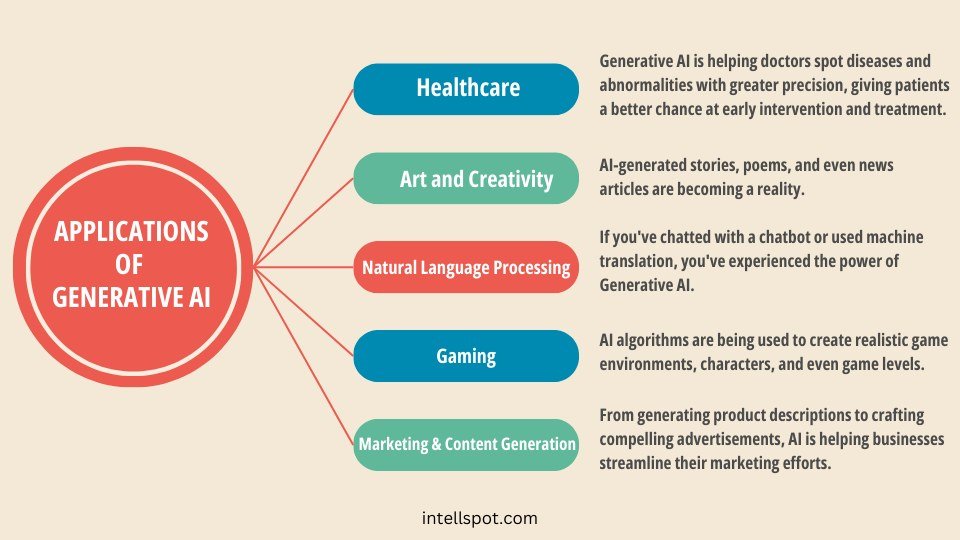
What Can Generative AI Do? Real-World Applications
A laptop screen shows generative AI creating text, images, and code simultaneously.
| Application | What It Does | Example Use |
|---|---|---|
| Text generation | Writes, summarizes, translates, and rewrites content | Drafting emails, reports, and social posts |
| Image generation | Creates or edits images from text descriptions | Concept art, product mockups, marketing visuals |
| Code generation | Writes, explains, and debugs code | Automating repetitive programming tasks |
| Audio and music | Generates speech, sound effects, and music | Voiceovers, podcasts, background scores |
| Video generation | Creates short clips from prompts | Social media content and storyboards |
| Document analysis | Summarizes long documents and extracts insights | Research, meeting notes, data cleanup |
Generative AI is also embedded in customer support chatbots, translation apps, design software, and medical research, where models help predict protein structures. The common thread: any task that involves producing structured, human-like output from a prompt is a candidate for generative AI.
Key Limitations and Challenges of Generative AI
Generative AI is powerful, but it is not magic. Understanding its limits is essential for using it safely.
- Produces original content in seconds, at scale
- Handles writing, visual, and coding tasks in one workflow
- Continuously improving with each new model generation
- Hallucinates false information with confidence
- Reflects and can amplify bias in training data
- Raises unresolved copyright, privacy, and energy concerns
Hallucination is the biggest practical risk. Because the model predicts the most likely next token rather than checking facts, it can produce statements that sound perfectly reasonable but are completely wrong. Bias is a second concern: models trained on internet data absorb the prejudices present in that data. Copyright and ownership questions are still being settled in courts, and the energy cost of training large models remains a real environmental issue.
None of these limitations mean generative AI should be avoided — they mean it should be used with oversight. Human review is still the most important quality control step.
Common Misconceptions About Generative AI
Because generative AI is new and impressive, several myths have grown up around it. Here are the most common ones.
“It actually thinks and understands.” It doesn’t. The model produces statistically plausible text based on patterns, with no inner experience or comprehension. It can discuss philosophy convincingly without understanding a single word.
“It’s always right.” Far from it. Models make mistakes, and the most dangerous mistakes are the ones delivered with complete confidence. Always verify important claims.
“It just copies from the internet.” In most cases, no. The model learns patterns and generates new combinations. That said, with frequently repeated content, a model can reproduce near-verbatim text, which is why copyright debates are ongoing.
“It will replace every job.” It automates tasks, not entire roles. Many jobs are being reshaped — some tasks disappear, new ones appear, and human judgment becomes more valuable, not less.
- Verify important facts against a reliable source
- Check each tool’s privacy policy before sharing sensitive information
- Review and edit AI output before publishing or sending it
- Treating AI output as expert advice without checking it
- Entering personal or confidential data into public tools
- Assuming the model’s knowledge is current
How to Choose and Start Using Generative AI Tools
Choosing the right tool depends less on which model is “smartest” and more on what you actually want to do. Start with your task, then pick the tool that fits.
For writing, brainstorming, or research help, a general-purpose chatbot is the easiest entry point. For images, a dedicated image generator will give far better results than a text chatbot. For code, look for an AI coding assistant that integrates with your editor. For voice or music, choose a specialized audio tool.
Most providers offer free tiers, so you can test quality and ease of use before paying. Pricing, features, and free-tier limits change frequently, so check the official product page for current details.
Specific prompts produce dramatically better results. Instead of “Write a post about coffee,” try “Write a 500-word post for small-business owners about choosing a home espresso machine, with a friendly tone and a section on common mistakes.” Give the model context, audience, length, and format.
Finally, build a habit of iteration. The first output is rarely the best. Refine your prompt, ask for revisions, and edit the result yourself. The best AI work comes from a collaboration between the model’s speed and your judgment.
The Future of Generative AI: A 2026 Perspective
By 2026, generative AI has settled into an everyday role in workplaces, classrooms, and creative studios. Several trends are worth watching.
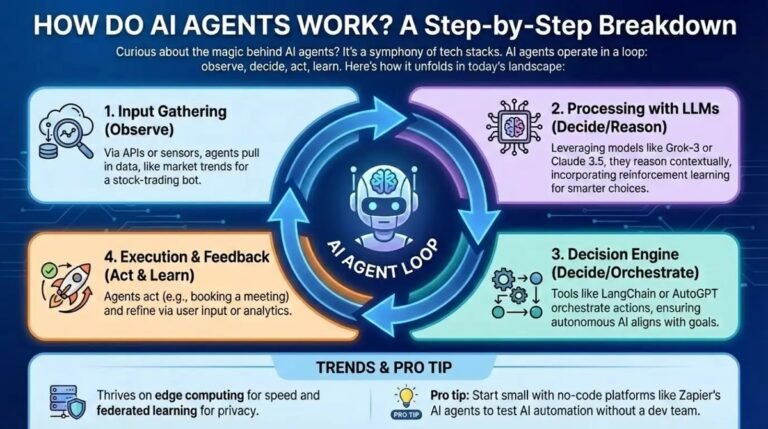
Multimodal models, which handle text, images, audio, and video in a single system, are becoming the norm. AI agents go a step further: instead of just generating content, they take actions — browsing, booking, writing code, and coordinating other tools. Meanwhile, smaller on-device models are improving privacy and lowering costs by running directly on laptops and phones.
Regulation is catching up. Frameworks such as the EU AI Act are introducing transparency and risk requirements, and ongoing copyright cases will help define what training data can legally be used. These developments will shape which tools are available and how they behave.
The technology will keep changing, but the fundamentals in this article — training data, neural networks, probability, prediction — remain the same. Understanding those basics is the best preparation for whatever comes next.
- Definition: Generative AI creates new content by learning patterns from training data and predicting what comes next.
- Main types: Transformers power text models; diffusion models power image and video generators.
- Applications: Writing, coding, images, audio, video, and document analysis are all well-established uses.
- Limitations: Hallucinations, bias, and privacy risks mean human oversight is essential.
- Getting started: Pick a free tool matched to your task, write specific prompts, and verify the output.
Frequently Asked Questions


5 Comments