What Is Quantum Computing in Simple Words Explained Simply
Quantum computing uses qubits that can exist in multiple states at once, allowing certain calculations to be performed far faster than classical computers. It’s a specialized technology still in early development, not a replacement for everyday computers.
If you’ve been looking for an answer to what is quantum computing in simple words, here it is: quantum computing is a new way of processing information that uses the principles of quantum physics to handle calculations far beyond the reach of today’s computers. Instead of relying on bits that are strictly 0 or 1, quantum computers use qubits that can exist in multiple states at once, allowing them to explore many possible answers simultaneously.
Quantum computing has become one of the most talked-about technologies of the decade, yet it’s also one of the most misunderstood. Headlines promise breakthroughs in medicine, cryptography, and artificial intelligence, but the reality is more nuanced. This guide breaks down how quantum computers work, what they can and can’t do, and why the field matters even if you never touch a quantum machine yourself.
- Qubits vs. bits: Qubits can be 0, 1, or both at once, enabling parallel processing that classical.
- Not universally faster: Quantum computers excel at specific problems like factoring, simulation, and optimization, not everyday tasks.
- Still early days: Error rates, extreme cooling needs, and high costs limit current quantum computers to research.
- Future impact: Quantum computing will reshape cybersecurity, medicine, finance, and AI over the next decade.
- Learn the basics now: Understanding key terms helps you evaluate quantum news and separate genuine progress from hype.
What Is Quantum Computing in Simple Words?
The Core Idea Behind Quantum Computing
At its heart, quantum computing applies the rules of quantum mechanics — the physics that governs atoms, electrons, and photons — to computation. These particles don’t behave like the objects we see around us. They can exist in multiple states at once, influence each other across distances, and only reveal definite properties when measured.
A quantum computer takes advantage of these behaviors to process information in a fundamentally different way than a classical computer. Where a traditional machine works through problems step by step, a quantum computer considers many possibilities at the same time. That parallel approach is what gives it the potential to solve certain problems that would take classical computers millions of years.
Qubits vs. Classical Bits: The Key Difference
Every classical computer — from a smartwatch to a supercomputer — stores information in bits. A bit is a binary value: it’s either 0 or 1. Everything your computer does, from rendering video to running spreadsheets, is built on billions of these simple on/off switches.
Qubits, or quantum bits, are different. A qubit can be 0, it can be 1, or it can be a combination of both at the same time. This is called a superposition. Because qubits can hold more information per unit than classical bits, a relatively small number of qubits can represent an astronomically large number of states simultaneously.
When you hear about a quantum computer with “50 qubits” or “100 qubits,” that number refers to the machine’s processing capacity. However, more qubits don’t automatically mean better performance — the quality and stability of those qubits matter just as much, and most current systems are still too error-prone for commercial use.
How Does a Quantum Computer Actually Work?
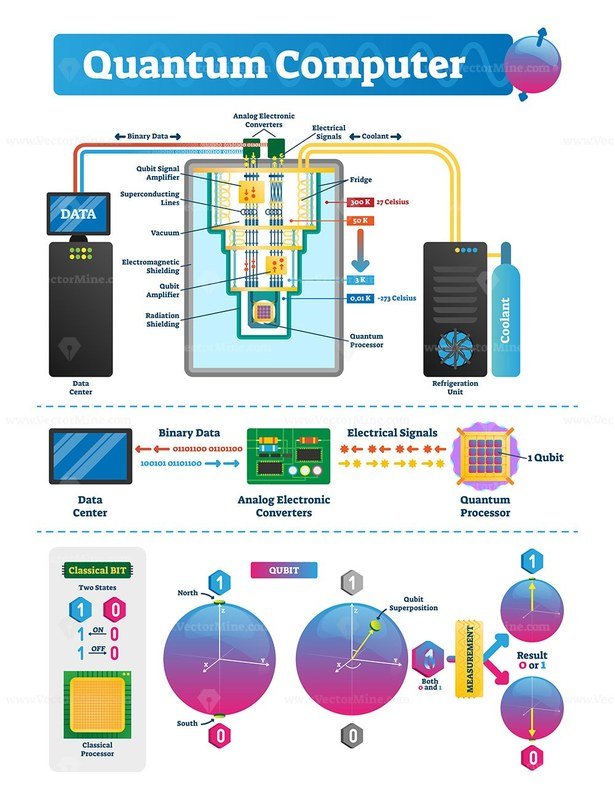
A simplified diagram illustrates how qubits use superposition and entanglement to process information.
Superposition: Being 0 and 1 at the Same Time
Superposition is the ability of a qubit to exist in multiple states at once. A helpful analogy is a spinning coin. While the coin is in the air, it isn’t clearly heads or tails — it’s a mix of both possibilities. A qubit in superposition is similar, except it can remain in that mixed state indefinitely until it’s measured.
This is what gives quantum computers their parallel processing power. With a handful of qubits in superposition, a quantum computer can represent 2 to the power of that number of states simultaneously. Ten qubits can represent 1,024 states; fifty qubits can represent over a quadrillion. That exponential growth is the source of quantum computing’s potential.
Entanglement: The Strange Connection That Makes It Powerful
Entanglement is a phenomenon where two or more qubits become linked so that the state of one instantly influences the state of the other, even if they’re separated by large distances. Albert Einstein famously called it “spooky action at a distance” because it seems to defy our everyday understanding of cause and effect.
In practical terms, entanglement allows quantum computers to coordinate the behavior of many qubits as a single system. This coordination is what enables quantum algorithms to solve complex problems that classical algorithms cannot. Without entanglement, a quantum computer would be little more than a collection of independent qubits.
Entanglement isn’t just a theoretical curiosity. It’s the foundation of quantum cryptography, a technology that could one day make data transmission virtually unhackable. If someone tries to intercept an entangled message, the quantum state is disturbed, alerting both sender and receiver.
Quantum Interference: How Results Are Reached
Quantum interference is the mechanism that turns a jumble of possibilities into a useful answer. During a calculation, the quantum states of qubits interact and interfere with one another. Some possibilities are amplified, while others cancel out. The correct answer becomes increasingly likely, and wrong answers fade away.
At the end of the calculation, the computer measures the qubits. Measurement forces each qubit to “choose” a definite state of 0 or 1, collapsing the superposition. The resulting sequence of bits is the answer. The challenge is designing algorithms that make the correct answer overwhelmingly likely — because in a noisy quantum system, errors can easily push the result in the wrong direction.
What Makes Quantum Computers So Powerful?
Speed and Problem-Solving Capabilities
Quantum computers aren’t faster at everything. They won’t make your web browser load quicker or your video game run smoother. Their advantage is specific: for certain types of problems, they can explore many solutions at once, dramatically reducing the time required.
The most famous example is factoring large numbers. Classical computers struggle with this because the number of steps grows extremely fast as the numbers get larger. A quantum algorithm called Shor’s algorithm can factor numbers exponentially faster. This matters because modern encryption relies on the difficulty of factoring — a quantum computer powerful enough to run Shor’s algorithm could break much of today’s encryption.
Key Differences From Your Everyday Computer
| Feature | Classical Computer | Quantum Computer |
|---|---|---|
| Basic unit | Bit (0 or 1) | Qubit (0, 1, or both) |
| Processing style | Sequential, step by step | Parallel, many states at once |
| Best at | Everyday tasks, general computing | Specific math, simulation, optimization |
| Error handling | Mature and reliable | Still being developed |
| Availability | Everywhere | Research labs and cloud services |
What Can Quantum Computing Be Used For?
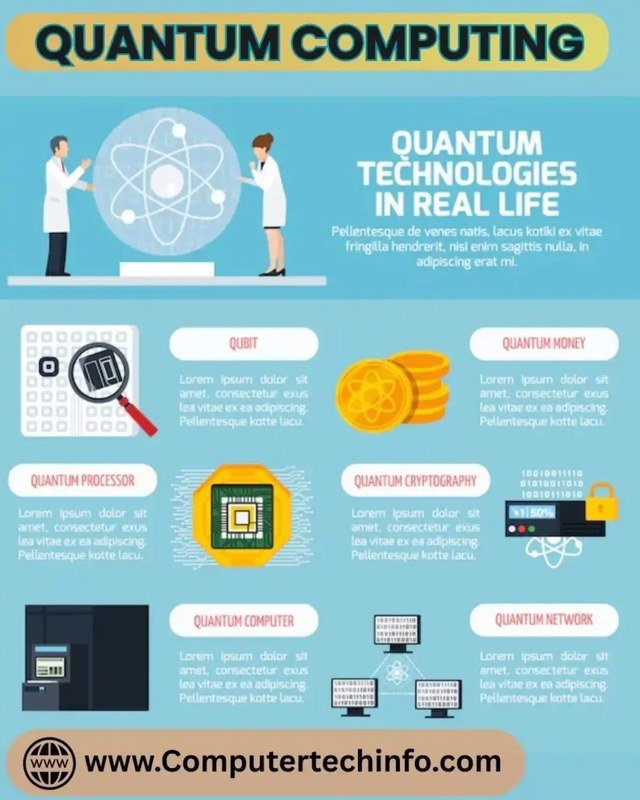
A quantum computer processor chip with intricate wiring and glowing components.
Real-World Applications to Watch in 2026 and Beyond
In 2026, quantum computing is still primarily a research tool, but the list of promising applications is growing. These are the areas where quantum computers could deliver real-world value in the coming years:
- Drug discovery and materials science: Quantum computers can simulate molecules and chemical reactions in ways classical computers cannot. This could speed up the development of new drugs, batteries, and solar panels.
- Cryptography: Quantum computers could break existing encryption methods, but they could also enable quantum-safe encryption that is far more secure.
- Logistics and optimization: Airlines, delivery companies, and manufacturers deal with complex routing and scheduling problems. Quantum algorithms could find better solutions faster.
- Financial modeling: Banks and investment firms are exploring quantum computing for portfolio optimization, risk analysis, and fraud detection.
- AI and machine learning: Quantum computing could accelerate training for machine learning models, a field already transforming industries. If you want to understand how AI systems learn in the first place, it helps to start with the basics of machine learning explained in simple terms.
Who Should Care About Quantum Computing?
You don’t need to be a physicist to care about quantum computing. The technology will eventually affect cybersecurity, medicine, energy, and finance — industries that touch everyone’s daily life. Understanding the basics now helps you evaluate news stories, make informed decisions about data security, and recognize when companies are overhyping their quantum credentials.
Students and professionals in tech, healthcare, and finance should pay particular attention. The skills needed to work with quantum systems are rare, and demand is expected to grow. In healthcare, for example, quantum simulations could complement the ways AI is already being used in healthcare to accelerate diagnosis and treatment discovery.
What Are the Limitations of Quantum Computing Today?
Error Rates and Stability Issues
Qubits are fragile. They’re easily disturbed by heat, electromagnetic radiation, and even tiny vibrations. Most quantum computers must be kept at temperatures close to absolute zero, colder than outer space, to reduce interference. Despite these precautions, errors remain common.
Quantum error correction is one of the biggest challenges in the field. Unlike classical bits, qubits can’t simply be copied or backed up — measuring them destroys their quantum state. Researchers are developing error-correcting codes that spread information across many physical qubits, but this requires a huge overhead. A single logical qubit may need hundreds or thousands of physical qubits to function reliably.
Cost, Size, and Accessibility Barriers
Building a quantum computer is extraordinarily expensive. The cooling systems alone are complex and costly, and the machines themselves fill entire rooms. Only a handful of organizations — including tech giants, national laboratories, and well-funded startups — have the resources to build and operate them.
Access is improving through cloud services. Several companies now offer quantum computing as a cloud service, allowing researchers to run experiments remotely without owning hardware. But practical, widespread adoption is still years away, and the field faces significant engineering hurdles before quantum computers become everyday tools.
Common Mistakes and Misconceptions About Quantum Computing
“It Will Replace Classical Computers”
Quantum computers will not replace your laptop, phone, or desktop. They are specialized tools designed for specific types of problems. Classical computers remain far better for everyday tasks like word processing, web browsing, and gaming. The future is likely hybrid: classical and quantum computers working together, each handling what it does best.
“It’s Just a Faster Version of a Normal Computer”
Quantum computers aren’t just faster classical computers. They operate on fundamentally different principles. A quantum computer can solve certain problems that would take a classical computer an impractical amount of time, but it’s not universally faster. For many tasks, a classical computer remains the better choice.
“Quantum Computers Are Ready for Everyday Use”
Despite bold headlines, quantum computers are not ready for mainstream use. Current machines are noisy, error-prone, and require specialized expertise to operate. The field is making steady progress, but practical, large-scale quantum computing is still a future goal rather than a present reality.
What to Look For When Reading Quantum Computing News
Evaluating Big Claims and Headlines
Quantum computing attracts hype, and not every headline is accurate. When reading about a new breakthrough, ask yourself a few questions: Was the result peer-reviewed? Did the researchers demonstrate a practical advantage over classical computers, or just a theoretical one? Was the experiment run on a real quantum computer or only simulated? These details matter more than the press release suggests.
Pay attention to the difference between “quantum advantage” — a demonstration that a quantum computer can outperform a classical one on a specific task — and “quantum supremacy,” a more ambitious claim that a quantum computer has solved a problem a classical computer practically cannot. Both terms are often used loosely in the media.
Key Terms You Should Understand
When you encounter a quantum computing article, look for these terms: qubit (the basic unit), superposition (multiple states at once), entanglement (linked qubits), decoherence (loss of quantum state), and error correction (fixing mistakes). If an article uses these terms correctly, it’s more likely to be reliable.
Final Recommendation: Is Quantum Computing Worth Your Attention?
The Value of Understanding Quantum Computing Now
Yes, quantum computing is worth your attention — not because you’ll buy one anytime soon, but because the technology will reshape fields like security, medicine, and artificial intelligence over the next decade. Understanding the basics now means you’ll be better prepared to evaluate the changes as they arrive.
Quantum computing also connects to other transformative technologies. The same way AI agents are changing how we interact with software, quantum computers could change what’s computationally possible. Being literate in these technologies isn’t just for engineers; it’s becoming part of being an informed citizen.
How to Get Started Learning More
If you want to go deeper, start with the fundamentals of physics and computer science. Many universities offer free introductory courses on quantum computing. IBM, Google, and Microsoft all publish educational resources and offer cloud access to real quantum hardware for experimentation.
Read widely, but critically. Follow reputable sources, look for peer-reviewed research, and be skeptical of sensational claims. Quantum computing is a marathon, not a sprint — and the more you understand it now, the better you’ll be able to separate genuine progress from hype.
- Quantum computing uses qubits: Unlike classical bits, qubits can exist in multiple states at once, enabling parallel processing.
- It’s not universally faster: Quantum computers excel at specific problems like factoring, simulation, and optimization, not everyday computing.
- It’s still early: Error rates, cost, and stability issues mean practical quantum computers are years away.
- It matters for the future: Quantum computing will impact cybersecurity, medicine, finance, and AI — fields that affect everyone.
Frequently Asked Questions