How Quantum Computing Could Affect Cybersecurity Now
Quantum computing threatens public-key encryption like RSA and ECC, but it will not break all encryption. The most urgent risk is “harvest now, decrypt later,” and crypto-agile migration to NIST-approved post-quantum algorithms is the practical defense.
Understanding how quantum computing could affect cybersecurity is no longer a theoretical exercise. In 2026, the conversation has shifted from research papers to boardroom agendas, government compliance roadmaps, and vendor product updates. The good news is that the path forward is clearer than it was a few years ago. The challenge is that most organizations still do not know which of their encrypted data is most exposed — or how quickly they need to act.
- Main threat: RSA and ECC public-key encryption are the primary targets for future quantum attacks.
- Urgent risk: Attackers can steal encrypted data now and decrypt it later once capable quantum computers.
- Strong defenses: AES-256 and NIST-approved post-quantum algorithms like ML-KEM and ML-DSA offer viable paths forward.
- Key capability: Crypto-agility lets organizations swap algorithms quickly without redesigning systems.
- Action now: Build an encryption inventory and prioritize data with long security lifespans.
What Is Quantum Computing and Why It Matters for Cybersecurity in 2026
Quantum computing is a different way of processing information, and it matters to cybersecurity because some of the math that protects modern digital systems was designed for classical computers. To understand the risk, it helps to start with the basic difference between how classical and quantum computers work. If you are new to the topic, our plain-language guide to what quantum computing is can bring you up to speed quickly.
The Core Difference: Bits vs. Qubits
A classical computer stores information as bits — each bit is either a 0 or a 1. Every file, password, and encrypted message you send is ultimately a long string of these bits. A quantum computer uses qubits, which can exist in a state called superposition, meaning a qubit can represent 0 and 1 at the same time. When qubits are linked through entanglement, the computer can explore many possible answers simultaneously.
That sounds powerful, and it is — for certain types of problems. Quantum computers are not faster at everything. They are expected to excel at specific mathematical tasks, and one of those tasks happens to be the math that secures much of the internet.
Why the Timeline Has Moved Up
For years, experts described quantum threats as decades away. That timeline has compressed for three practical reasons. First, the U.S. National Institute of Standards and Technology (NIST) finalized its first post-quantum encryption standards in 2024, giving organizations a concrete migration target. Second, government agencies in the United States and elsewhere now face formal deadlines to move to quantum-safe systems. Third, major cloud providers and security vendors have begun shipping quantum-safe and hybrid encryption options, which means the tools are no longer experimental.
None of this means a quantum computer will break RSA encryption next year. It means the planning window is now, and the cost of waiting grows each quarter.
The Short Answer: How Quantum Computing Could Affect Cybersecurity Now

A quantum computer chip with a padlock icon, illustrating the intersection of quantum computing and cybersecurity.
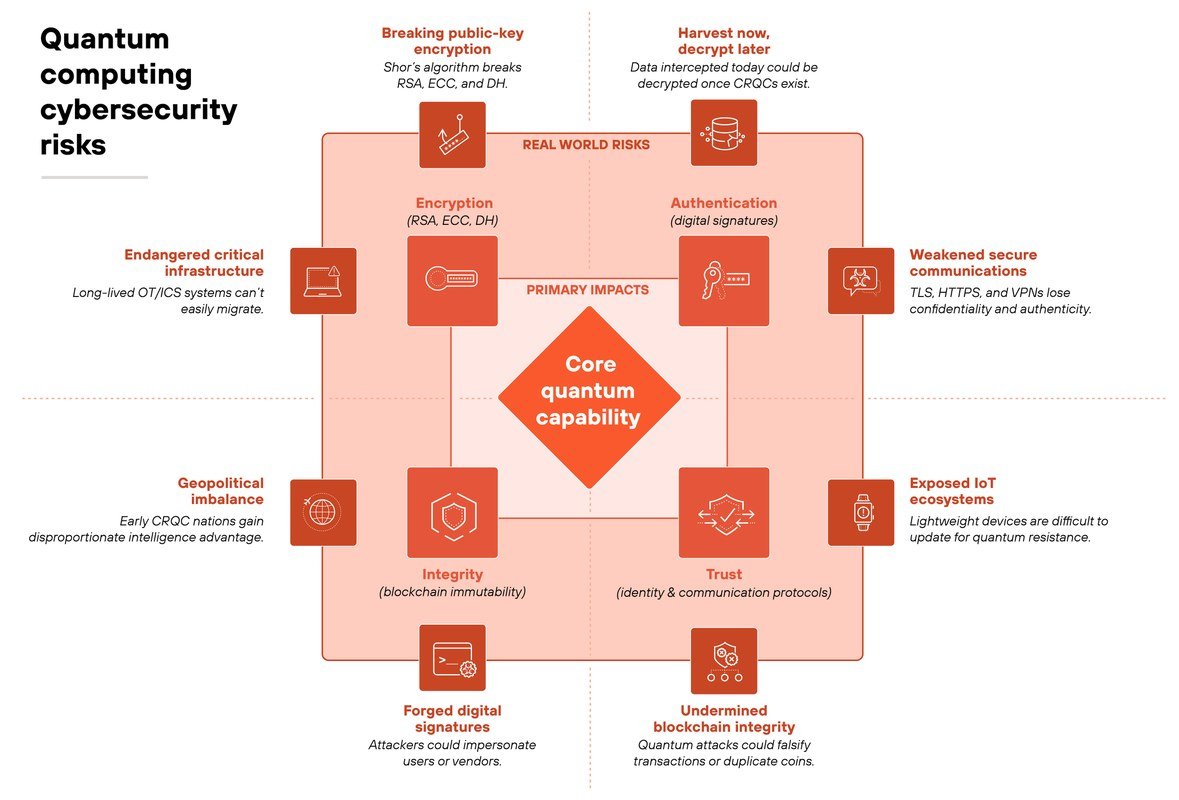
Here is the direct answer: quantum computing threatens the public-key encryption that protects most internet traffic, digital signatures, and secure communications — but it does not threaten every type of encryption equally. Symmetric algorithms like AES-256 are expected to remain secure, although their effective strength may be reduced. The immediate practical risk is not a sudden collapse of the internet; it is the quiet theft of encrypted data that will be decrypted later, once a capable quantum computer exists.
That is why the field has shifted from “if” to “when.” Security teams that treat quantum readiness as a 2030 problem are already behind, because data stolen today can be unlocked tomorrow. For a broader look at current threats and defenses, our cybersecurity coverage tracks these developments as they evolve.
The Threat Side: Which Encryption Standards Are Most Vulnerable
Not all encryption is created equal, and understanding the difference is the first step in a realistic risk assessment.
RSA and Elliptic Curve Cryptography at Risk
The most widely used public-key systems — RSA and Elliptic Curve Cryptography (ECC) — rely on math problems that are hard for classical computers but potentially easy for a sufficiently powerful quantum computer. Peter Shor’s algorithm, published in 1994, showed that a large-scale quantum computer could factor large numbers and solve discrete logarithms efficiently. Those two problems are exactly what RSA and ECC depend on for their security.
This matters because RSA and ECC are everywhere: TLS certificates that encrypt website traffic, digital signatures that verify software updates, VPN handshakes, and the key exchange protocols used in email and messaging. If a large fault-tolerant quantum computer becomes available, an attacker with one could decrypt intercepted traffic and forge digital signatures.
The “Harvest Now, Decrypt Later” Problem
The most urgent threat is not the quantum computer itself — it is the data being collected right now by attackers who expect to decrypt it later. This is called “harvest now, decrypt later.” Adversaries copy encrypted data today, store it, and wait until they have the means to decrypt it.
Encrypted data with a long useful life — such as medical records, legal documents, and government secrets — is the most valuable target for harvest-now attacks because it still matters years after it is stolen.
This is why waiting for a confirmed “quantum break” date is a mistake. By the time a quantum computer publicly breaks RSA, the data that should have been protected will already be in the wrong hands.
The Opportunity Side: Quantum-Safe Cryptography and New Defenses<

Illustration of a quantum-resistant encryption shield protecting data.
Illustration of a quantum-resistant encryption shield protecting data.
Quantum computing is not only a threat. It is also driving the development of stronger cryptographic tools and forcing the industry to fix weaknesses that have been ignored for years.
NIST-Approved Post-Quantum Algorithms
In August 2024, NIST finalized three post-quantum encryption standards: ML-KEM (FIPS 203) for general encryption, ML-DSA (FIPS 204) for digital signatures, and SLH-DSA (FIPS 205) as a backup signature scheme. These algorithms are designed to resist attacks from both classical and quantum computers.
During the transition, many vendors are using hybrid certificates that combine a traditional algorithm like ECC with a post-quantum algorithm. This approach keeps compatibility with older systems while adding quantum resistance.
Adopting these standards is not a single project. It requires updating libraries, certificates, protocols, and endpoints across an entire organization — which is exactly why the work needs to start well before the algorithms are urgently required.
Quantum Key Distribution (QKD) and Its Limits
Quantum Key Distribution takes a different approach. Instead of relying on mathematical hardness, QKD uses the physics of quantum mechanics to distribute encryption keys. If an eavesdropper tries to intercept the key, the quantum states are disturbed, and both parties can detect the intrusion.
QKD is genuinely interesting for high-security environments, but it has real limitations. It typically requires dedicated fiber-optic links or satellite connections, has distance constraints, and needs specialized hardware. For most organizations, NIST-approved post-quantum algorithms are the practical path forward, with QKD reserved for very specific high-risk use cases.
What to Look For in a Quantum-Safe Security Strategy
A quantum-safe strategy is less about buying a specific product and more about building a capability. Here is what to evaluate.
Crypto-Agility: The Must-Have Capability
Crypto-agility is the ability to replace cryptographic algorithms and keys quickly without redesigning entire systems. It is the single most important capability for quantum readiness, because no one knows exactly which algorithm will be needed in ten years.
Start by building a complete inventory of where encryption is used — certificates, VPNs, databases, APIs, email, and third-party services. You cannot migrate what you cannot find.
Ask vendors whether their products support algorithm replacement through configuration changes rather than full upgrades. If a product requires a forklift upgrade to change its encryption, that product is not crypto-agile.
Vendor Readiness and Compliance Deadlines
Every organization depends on third-party software, and a quantum-safe strategy is only as strong as the weakest vendor. Ask your critical vendors for their post-quantum roadmap, including which NIST algorithms they support and when they plan to ship them.
Compliance deadlines are also arriving. U.S. federal agencies have been directed to migrate to post-quantum cryptography, with a target of 2035 for most systems. Regulated industries such as finance and healthcare are likely to follow with their own requirements. Even if your organization is not regulated, your customers and partners may soon require quantum-safe connections.
Who Should Prepare First: Industries and Use Cases
Some organizations need to act faster than others. The deciding factor is the lifespan of the data they protect.
Government, Defense, and Critical Infrastructure
Government and defense agencies handle classified information that must remain secret for decades. Critical infrastructure — power grids, water systems, transportation — relies on long-lived control systems that are difficult to update. For these sectors, the harvest-now threat is existential, and migration is already underway in many countries.
Financial Services, Healthcare, and Cloud Providers
Financial records and health data also have long retention requirements. A mortgage record or a genomic dataset is still sensitive years after it is created. Cloud providers face a unique challenge: they must offer quantum-safe options to millions of customers while migrating their own internal systems.
If your organization stores data that will still be sensitive in ten years, the time to plan is now — regardless of your industry. Digital privacy concerns are already reshaping how people think about data collection, and quantum readiness is the next layer of that same conversation. For a related look at how artificial intelligence is changing the privacy landscape, see how AI can affect personal privacy.
Benefits, Limitations, and Common Mistakes
A balanced view of quantum readiness helps avoid both panic and complacency.
Benefits of Early Quantum Readiness
The benefits of starting early are practical. You protect long-lived data from future decryption, reduce the risk of an emergency migration, and gain a compliance advantage as regulations tighten. Organizations that migrate calmly, on their own schedule, make fewer errors than those forced into a rushed transition.
Limitations of Today’s Quantum Technology
It is also important to be clear about what quantum computers cannot do today. Current machines are noisy and error-prone, and no one has demonstrated a quantum computer capable of breaking real-world RSA encryption. The threat is real, but it is not imminent in the sense of a specific date. That uncertainty is precisely why a flexible, crypto-agile approach is better than trying to predict the exact moment of crisis.
Common Mistakes in Quantum Transition Planning
Most organizations make predictable mistakes when they start planning. Here is what to avoid.
- Inventory all encryption usage before choosing new algorithms.
- Prioritize data by sensitivity and how long it must stay secret.
- Require crypto-agility in every new product purchase.
- Waiting for a single “quantum apocalypse” date that may never arrive.
- Assuming all encryption is equally vulnerable — symmetric crypto still has a strong future.
- Treating quantum readiness as an IT-only project when it is a business risk issue.
The Bottom Line: Value and Final Recommendation
Quantum computing will affect cybersecurity, but the impact will be gradual and manageable for organizations that prepare. The threat is concentrated in public-key encryption, the most urgent risk is harvest-now data theft, and the solution is a crypto-agile migration to NIST-approved post-quantum algorithms.
- RSA and ECC are the main targets; AES-256 remains strong.
- “Harvest now, decrypt later” is the most immediate practical risk.
- NIST-approved post-quantum algorithms are ready for adoption.
- Crypto-agility and vendor readiness are the two capabilities to build first.
- Start with a full inventory of where encryption is used.
The final recommendation is straightforward: do not wait for a dramatic breakthrough to justify action. Build your encryption inventory, identify data with a long security lifespan, and adopt a crypto-agile posture this year. The organizations that treat quantum readiness as a gradual, well-planned migration — rather than an emergency — will be the ones that come through it with their data, their reputation, and their compliance record intact.
Frequently Asked Questions