How Search Engines Understand User Intent And Why It Matters
Search engines rank pages by how well they match the goal behind a query, not just the words in it. Aligning your content with the four intent types — informational, navigational, transactional, and commercial investigation — is the most reliable way to improve rankings and conversions.
Understanding how search engines understand user intent is the foundation of every successful content strategy. When you know what a searcher is really trying to accomplish, you can create pages that answer the right question in the right format — and that alignment is exactly what modern ranking systems reward.
- Intent is the goal behind a query: Search engines reward pages that satisfy what the searcher wants to accomplish.
- Four core intent types: Informational, navigational, transactional, and commercial investigation each require a different content format.
- Signals matter: Query wording, click behavior, dwell time, and semantic context all help engines decode intent.
- AI changed the game: Machine learning and natural language processing let engines understand meaning instead of just matching.
- Alignment drives results: Matching format to intent improves rankings, engagement, and conversion rates.
What Is User Intent and Why Do Search Engines Care?
Defining User Intent in the Context of Search
User intent — often called search intent — is the underlying goal a person has when they type a query into a search box. It is not simply the literal meaning of the words they use. Someone searching “best running shoes” may want reviews, price comparisons, or recommendations depending on where they are in their decision process. The same words can carry different intentions on different days, from different devices, or in different locations.
For content creators, the practical takeaway is simple: intent is the “why” behind the query, while keywords are only the “what.” Two pages can target the same keywords and still fail completely if they misunderstand the reason the searcher is there.
Why Decoding Intent Is the Core Job of a Search Engine
A search engine’s entire purpose is to connect a query with the most useful result. If it cannot determine whether a user wants a quick definition, a specific website, or a product to buy, every other ranking factor becomes meaningless. Relevance is measured against intent, not against keywords alone.
This is why search engines invest so heavily in understanding language, behavior, and context. The better an engine can predict what you actually want, the more likely you are to return tomorrow. For site owners, the same logic applies in reverse: pages that satisfy intent earn better engagement, and engagement feeds back into rankings.
The Core Types of User Intent Search Engines Recognize
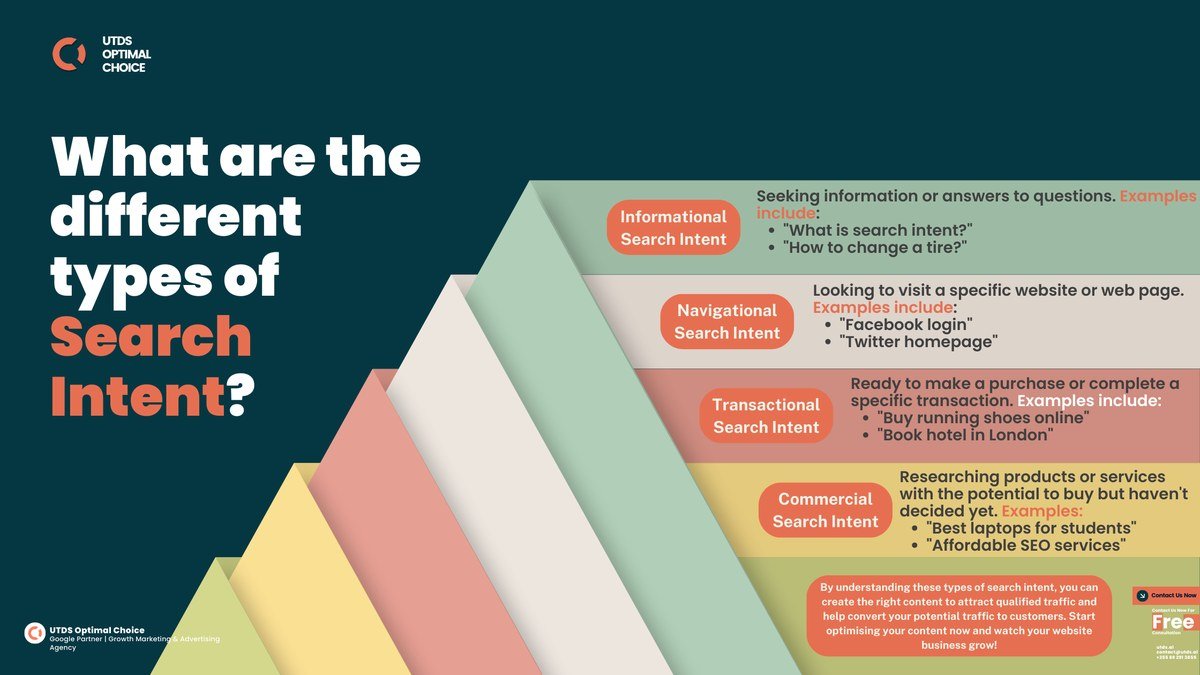
A chart illustrating the main categories of search intent recognized by search engines.
Search engines generally group queries into four broad intent categories. Most real-world searches fall into one of these buckets, and each one demands a different content response.
Informational Intent: Seeking Answers and Knowledge
Informational queries are the largest category. Searchers want to learn something: “how to fix a leaky faucet,” “what is machine learning,” “why do cats purr.” They are not ready to buy, and they usually expect a clear, authoritative explanation. Content that serves this intent well uses plain language, logical structure, and direct answers early in the page.
Navigational Intent: Finding a Specific Site or Page
Navigational queries happen when someone already knows where they want to go. Typing “gmail login,” “YouTube,” or “Amazon returns” signals a desire to reach a specific destination. Search engines typically surface the official page, and there is little room for third-party content to compete. If your brand owns the destination, the priority is making sure the right page is indexed and clearly labeled.
Transactional Intent: Ready to Buy or Convert
Transactional queries include words like “buy,” “order,” “subscribe,” “price,” or “near me.” The searcher has made a decision and wants to act. Product pages, checkout flows, and service booking pages are the natural matches here. Speed, clarity, and trust signals matter more than long-form storytelling.
Commercial Investigation: Comparing Options Before Deciding
Commercial investigation sits between informational and transactional intent. Queries like “best laptop for video editing,” “iPhone vs Android,” or “top CRM software reviews” show someone researching before a purchase. They want comparisons, honest pros and cons, and expert perspectives — not a hard sell and not a generic encyclopedia entry.
| Intent Type | Typical Query Patterns | What the Searcher Wants | Best Content Format |
|---|---|---|---|
| Informational | “how to,” “what is,” “why does” | Answers and knowledge | Guides, tutorials, explainers |
| Navigational | Brand names, “login,” “official site” | A specific page or site | Official pages, clear indexing |
| Transactional | “buy,” “order,” “price,” “near me” | Complete a purchase or signup | Product pages, booking flows |
| Commercial investigation | “best,” “review,” “vs,” “top 10” | Compare options before deciding | Comparisons, roundups, reviews |
The Signals Search Engines Use to Decode Intent
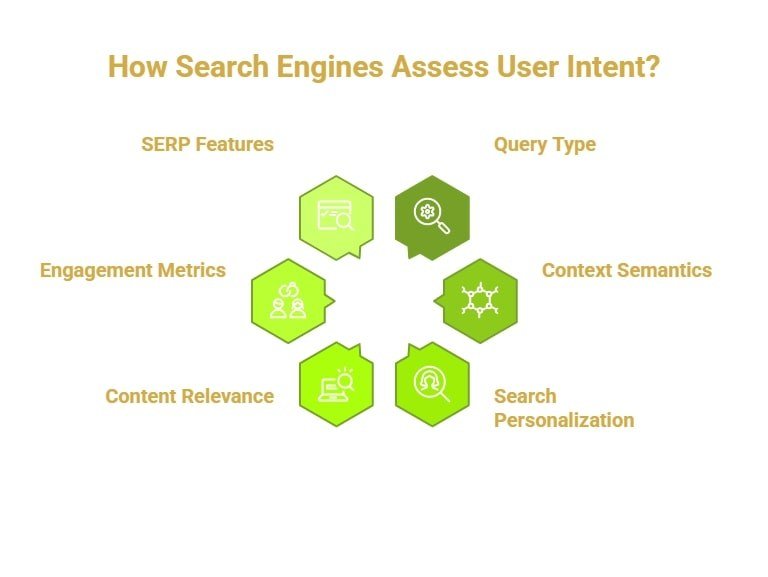
Search engines do not read minds. They piece together intent from a combination of signals that fall into three broad groups: the query itself, the searcher’s behavior, and the surrounding context.
Query Wording, Syntax, and Modifiers
The words people choose carry strong intent clues. “How to” signals informational intent; “buy” signals transactional intent; “best” and “vs” signal commercial investigation. Modifiers like “for beginners,” “for small businesses,” or “near me” refine the intent further. Search engines also pay attention to query length — longer, more specific queries usually indicate clearer intent than short, ambiguous ones.
Click-Through Rates, Dwell Time, and Bounce Behavior
Once results are shown, behavior becomes evidence. If a result earns clicks but users immediately bounce back to the search results, the engine treats that as a sign the page did not match intent. Longer dwell time — the time a user spends on a page before returning — suggests the content satisfied the query. Search engines do not publish the exact thresholds they use, but the pattern is well established: pages that satisfy searchers tend to earn stronger positions over time.
Semantic Search and Contextual Clues from the Searcher
Semantic search is the process of understanding meaning rather than just matching words. Engines look at the relationships between words in a query and compare them with the content of candidate pages. They also use context: a search for “apple” on a phone near a grocery store may lean toward the fruit, while the same query on a developer’s laptop may lean toward the company. Location, device type, time of day, and recent search history all help engines narrow down which meaning applies.
The word “bank” can refer to a financial institution, the land beside a river, or a basketball shot that bounces off the backboard. Search engines decide which meaning applies by looking at the words around it and the searcher’s context — a process known as word sense disambiguation.
How AI and Machine Learning Transformed Intent Recognition<

AI system mapping search queries to user intent categories.
AI system mapping search queries to user intent categories.
From Keyword Matching to Understanding Meaning
Early search engines relied on exact keyword matches: a page containing the query’s words in the right places ranked well. That approach broke down quickly because it ignored synonyms, word order, and genuine meaning. Modern systems use machine learning models trained on enormous amounts of language data to represent the meaning of a query and a document in comparable ways. This shift is a key part of what AI search is and how it works today.
The Role of Entity-Based Search and Natural Language Processing
Entity-based search treats real-world things — people, places, organizations, products — as connected nodes rather than isolated keywords. A query about “the Eiffel Tower” connects to facts about its location, height, and history, allowing the engine to answer directly instead of merely listing pages. Natural language processing (NLP) lets engines parse conversational phrasing, which is why you can type a full question into a search box and still get useful results. The same underlying technology powers how chatbots understand human language, and it has become central to search as well.
AI-generated overviews, which now appear at the top of many search results, add another layer. These summaries are built from the same intent-understanding systems, and they change what users expect from a search session. If you want to see how this affects visibility, it helps to understand how Google AI Overview works and what kind of content it pulls from.
Why Understanding User Intent Matters for Your Content Strategy
Matching Content Formats to What Users Actually Want
Format is part of intent. A person with informational intent wants an explainer, a tutorial, or a FAQ. A person with transactional intent wants a product page with clear pricing and a checkout button. A person with commercial investigation intent wants a comparison table and honest trade-offs. Publishing the wrong format — a sales page where someone wanted education, or a blog post where someone wanted to buy — will fail regardless of how well it is written.
Before you write a single word, search for your target keyword and study the top results. The formats that already rank are a strong signal of what search engines believe users want for that query.
Improving Rankings, Engagement, and Conversion Rates
When content matches intent, everything else gets easier. Users stay longer, scroll further, share the page, and return for more. Those behaviors feed into the engagement signals described earlier, which can lift rankings. On the conversion side, a transactional page that answers objections and makes the next step obvious will outperform a generic article every time. Intent alignment is not a separate SEO tactic; it is the foundation that makes other tactics work.
Common Mistakes That Confuse Search Engines and Users
Keyword Stuffing and Ignoring Long-Tail Queries
Keyword stuffing — repeating the same phrase unnaturally in headings, paragraphs, and meta tags — no longer works and actively hurts readability. It also signals to search engines that the page was built for robots rather than people. At the same time, ignoring long-tail queries is a missed opportunity. Long-tail searches are more specific, which usually means the intent is clearer and the competition is lower.
Creating Content That Targets the Wrong Intent Type
One of the most common failures is publishing a product review when the searcher wanted to buy, or publishing a sales page when the searcher wanted education. Another version of the same mistake is trying to satisfy every intent in a single page, which usually satisfies none. A page that tries to be a tutorial, a comparison, and a checkout flow all at once will feel scattered and earn weak engagement.
Overlooking Freshness and Relevance Signals
Some topics demand fresh information. A guide to current software pricing, a news story, or a list of trending tools becomes less useful as it ages. Search engines track freshness signals, and users notice stale content immediately. For evergreen topics, regular reviews and updates keep the page aligned with current reality — and with the intent of someone searching today.
- Study the current search results before you create or update a page.
- Match your content format to the dominant intent type for each keyword.
- Refresh old posts that are losing traffic or showing outdated information.
- Stuffing the same keyword into every heading and paragraph.
- Writing one page that tries to cover informational, transactional, and comparison intent at once.
- Assuming intent never changes — revisit your keyword mapping regularly.
How to Align Your Content with Each Intent Type
Structuring Informational Pages for Quick Answers
Informational pages should answer the core question in the first paragraph or two, then expand with context, examples, and practical steps. Use descriptive headings that mirror the way people ask questions, and include a short summary or key-takeaways block near the top. Readers scanning for one fact should be able to find it without reading the entire page.
Optimizing Product and Service Pages for Transactional Queries
Transactional pages need to remove friction. State what you are selling, show the price clearly (or explain that it varies by configuration), and make the next step obvious. Include trust signals such as return policies, warranty terms, and customer support contact details. If pricing or availability changes by region or model, say so plainly instead of hiding the uncertainty.
Using Comparison Content for Commercial Investigation
Comparison content should evaluate the same criteria for every option. Explain your evaluation criteria up front, present a balanced view of strengths and limitations, and recommend different options for different use cases. A comparison that only lists positives reads as an ad, and searchers in the investigation phase are specifically looking for honest trade-offs.
List your top pages and identify which intent type each one targets. Look for mismatches between the query and the format.
Group your keywords by intent and assign a content format to each group — guide, product page, comparison, or tool.
Adjust headings, structure, and calls to action so the page matches what the searcher wants to do next.
The Future of Intent Understanding and Final Recommendations
What to Expect from Search Engines in 2026 and Beyond
In 2026, search is increasingly conversational and AI-assisted. Users expect direct answers, follow-up questions, and results that adapt to their context. Search engines are getting better at recognizing not just what a query means, but what stage of a journey the searcher is in. That means intent recognition will keep moving from categories toward predictions — anticipating the next question before it is asked.
Practical Next Steps for Site Owners and Content Teams
Start with a simple audit of your existing content. For each important page, ask three questions: Who is searching for this, what do they want to accomplish, and does my page help them do it? Then adjust your formats, refresh stale pages, and monitor how engagement changes over time. Intent is not a one-time consideration; it is a continuous part of creating content that earns attention.
- User intent is the goal behind a query, and search engines rank pages that satisfy that goal.
- The four core intent types — informational, navigational, transactional, and commercial investigation — each demand a different content format.
- Search engines decode intent through query wording, behavioral signals, semantic understanding, and searcher context.
- Aligning content with intent improves rankings, engagement, and conversions — and avoids the common mistakes that confuse both users and algorithms.
Frequently Asked Questions


2 Comments