What is Deep Learning in Simple Words A Beginners Guide
Deep learning is a branch of machine learning that uses layered neural networks to learn patterns directly from data. It powers the face recognition on your phone, voice assistants, and generative AI tools.
If you have been wondering what is deep learning in simple words, here is the short version: deep learning is a branch of machine learning that teaches computers to learn from examples using layered neural networks, much like the human brain processes information. Instead of following hand-coded rules, a deep learning system finds patterns in data on its own, which is why it powers everything from voice assistants to photo recognition.
- Definition: Deep learning uses multi-layered neural networks to learn patterns from data without hand-coded rules.
- Relationship: It is a subset of machine learning, which itself is a subset of artificial.
- Essentials: Data, model architecture, and compute power are the three ingredients every system needs.
- Applications: It powers computer vision, speech recognition, natural language processing, and generative AI.
- First step: Python, a free GPU notebook, and a small project are enough to begin learning.
What Is Deep Learning in Simple Words?
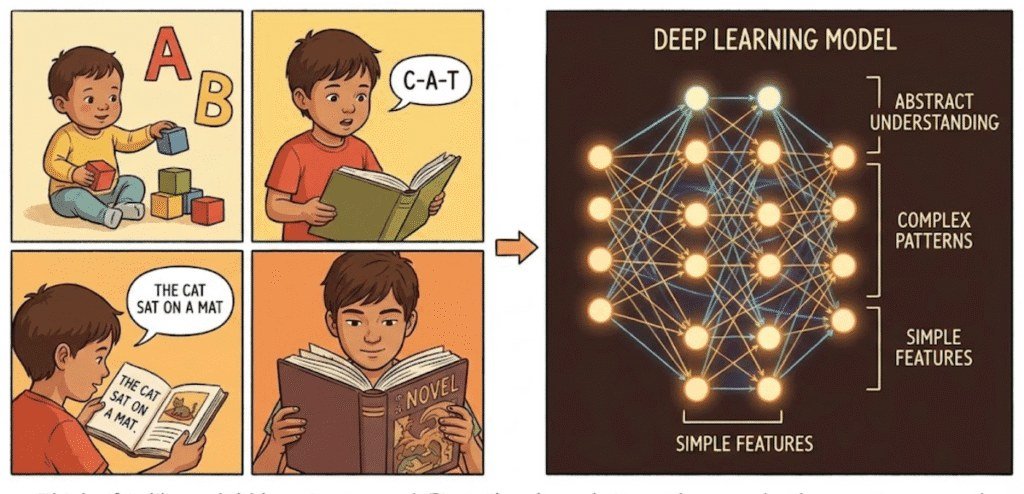
Deep learning is a method of training computers to perform tasks by showing them large amounts of data and letting them discover patterns. It is called “deep” because it uses many layers of artificial neurons stacked together. Each layer extracts a slightly more complex feature from the input, and together these layers build a sophisticated understanding of the data.
Deep Learning vs. Machine Learning vs. Artificial Intelligence
Artificial intelligence is the broadest umbrella term. It covers any technique that lets machines mimic human intelligence, from simple rule-based systems to advanced chatbots. Machine learning is a subset of AI where systems learn from data instead of being explicitly programmed. Deep learning is a further subset of machine learning that uses multi-layered neural networks to handle very complex patterns.
| Level | What It Means | Everyday Example |
|---|---|---|
| Artificial Intelligence | Any machine that mimics human intelligence | Chess program with hand-coded rules |
| Machine Learning | Systems that learn patterns from data | Spam filter that improves with examples |
| Deep Learning | Multi-layered neural networks that learn complex features | Face recognition on a phone |
If you want a deeper look at the foundation, our guide to what is artificial intelligence in simple words explains how the field fits together, and our breakdown of what is machine learning in simple terms covers the middle layer of the stack.
Why “Deep” Matters: A Quick Analogy
Think of teaching a child to recognize a cat. You do not hand the child a rulebook. Instead, the child sees many cats and gradually learns the patterns: pointy ears, whiskers, and a tail. Deep learning works the same way. The “depth” refers to the number of layers in the network. More layers allow the system to learn more abstract ideas, starting with simple edges and lines, then shapes, and finally full objects.
The term “deep learning” gained wide attention in the mid-2000s when researchers showed that neural networks with many layers could be trained effectively. Earlier attempts often stalled because the networks were too shallow to capture complex patterns.
How Deep Learning Works: A Plain-English Explanation
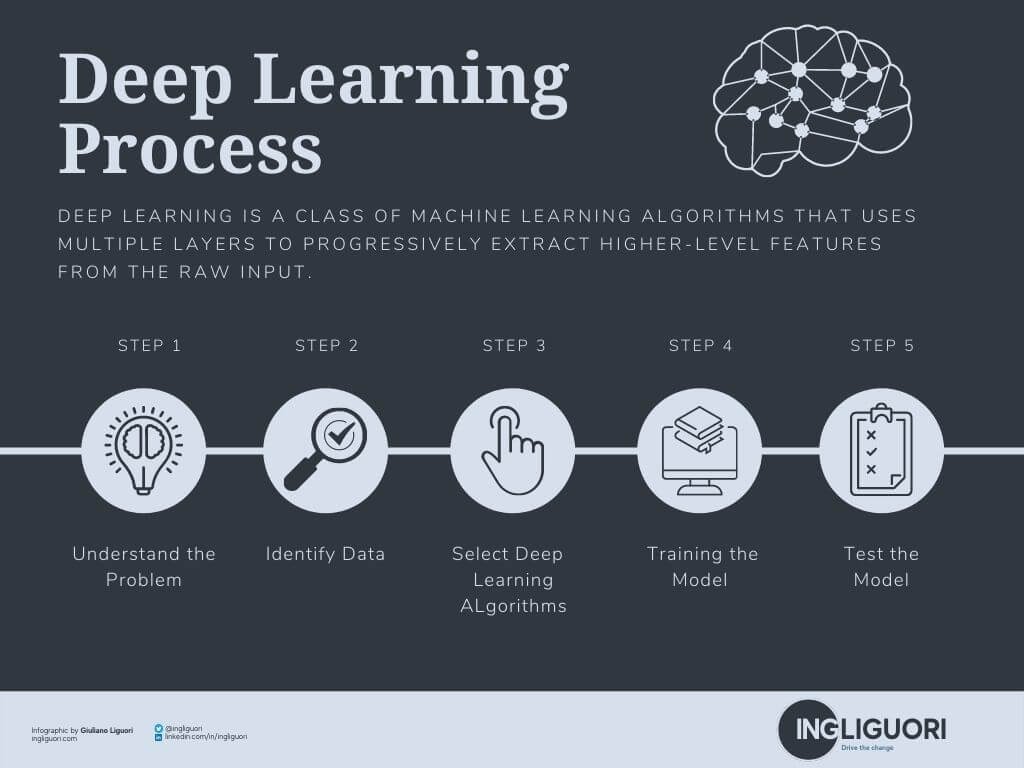
A simple neural network diagram shows how data flows through layers.
At its core, deep learning is a pattern-finding process. You feed a system examples, it makes guesses, and it corrects itself until its guesses become reliable. Understanding two ideas helps: how neural networks are built and how training improves them.
The Role of Neural Networks
A neural network is a collection of small computing units called neurons, organized into layers. The first layer receives the raw input, such as the pixels of an image. The last layer produces the output, such as “this is a dog.” Between them sit hidden layers that transform the data step by step. Each connection between neurons has a weight, and those weights determine how strongly one neuron influences the next.
Training a Model: Data, Learning, and Feedback
Training is where the magic happens. The model is fed examples, makes a prediction, and then adjusts its weights based on how wrong the prediction was. This loop repeats millions of times until the model becomes accurate.
The model looks at an example and produces a prediction using its current weights.
The system measures the difference between the prediction and the correct answer.
The model works backward through the layers, updating each weight to reduce the error.
This cycle continues across thousands or millions of examples until accuracy improves.
Key Ingredients of a Deep Learning System
Every deep learning project relies on three essential ingredients. If any one is missing or weak, the whole system underperforms.
Data: The Fuel That Powers Learning
Deep learning models are data hungry. A model trained to recognize handwritten digits might need tens of thousands of examples. A large language model trains on billions of words. The quality of the data matters as much as the quantity. Messy, biased, or mislabeled data produces unreliable models, so cleaning and organizing data is often the most time-consuming part of any project.
Model Architecture: The Brain Behind the Scenes
The architecture describes how layers are arranged and connected. Different tasks call for different designs. Convolutional neural networks excel at images, while transformer architectures power most modern language models. Choosing the right architecture is a skill in itself, and researchers constantly develop new designs that improve efficiency and accuracy.
Compute Power: The Engine That Makes It Run
Training a deep learning model requires serious computing power. Graphics processing units, or GPUs, are popular because they can perform many calculations at once. Cloud services let individuals rent this power by the hour, which is why deep learning is no longer limited to large corporations. Even so, training large models can take days or weeks and can be expensive.
Real-World Applications: What Deep Learning Can Do<
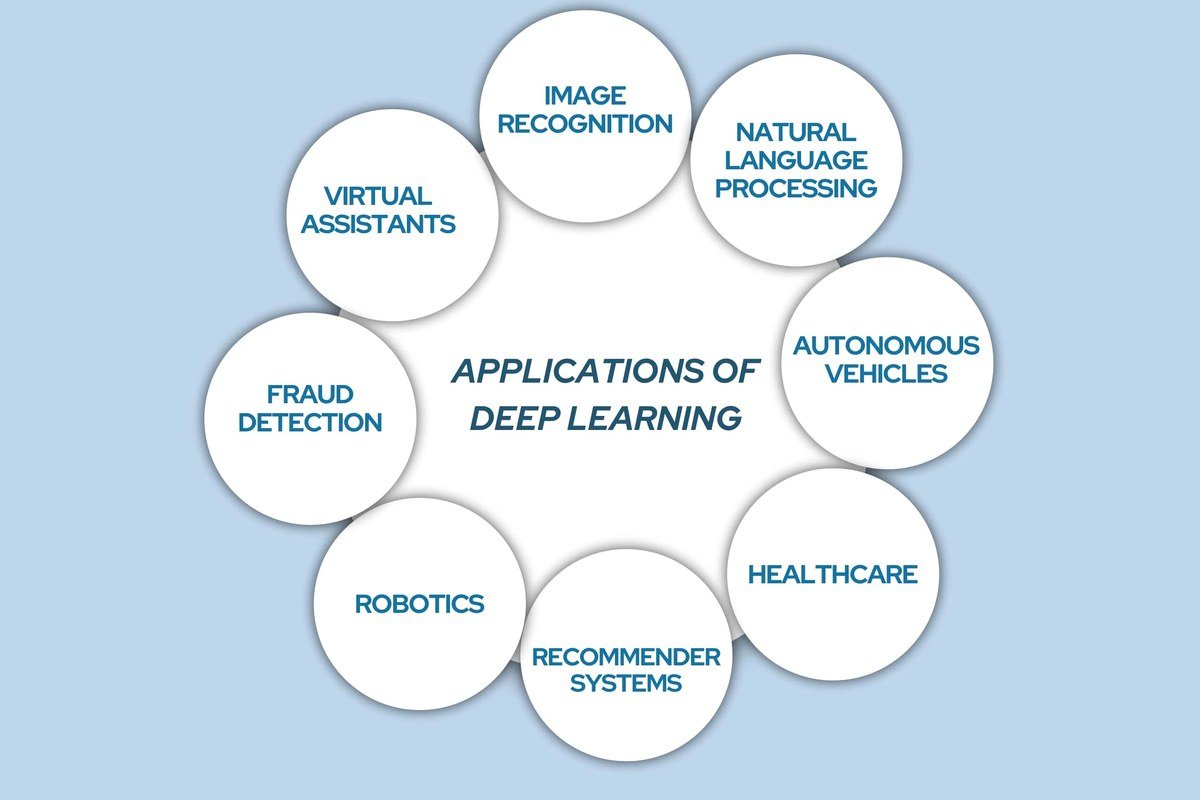
Deep learning powers everyday tools like voice assistants, facial recognition, and autonomous vehicles.
Deep learning powers everyday tools like voice assistants, facial recognition, and autonomous vehicles.
Deep learning is not a lab curiosity. It is already woven into the products and services you use daily.
Computer Vision and Speech Recognition
Deep learning is behind the face unlock on your phone, the automatic tagging in your photo app, and the voice assistant that understands your requests. Medical imaging systems use deep learning to spot abnormalities in X-rays and MRIs, often matching or exceeding human performance on specific tasks. Self-driving cars rely on deep learning to identify pedestrians, traffic signs, and road conditions in real time.
Natural Language Processing and Generative AI
Language models, translation tools, and chatbots all depend on deep learning. These systems learn grammar, context, and meaning by analyzing enormous amounts of text. Generative AI tools that write essays, create images, or summarize documents are built on deep learning architectures. If you want to understand that layer better, our article on what is generative AI and how does it work walks through the mechanics.
Beyond these headline uses, deep learning quietly shapes daily life in ways you may not notice, from recommendation engines to fraud detection. Our overview of how AI is changing everyday life highlights many of these behind-the-scenes applications.
Who Should Learn About Deep Learning? And Why It Matters
Deep learning is not just for researchers. It has become relevant to students, professionals, and business leaders alike.
For Students and Career Changers
Deep learning is one of the most in-demand technical skills in the job market, and you do not need a PhD to get started. Many practitioners enter the field through online courses, personal projects, and open-source tools. A solid foundation in Python, basic statistics, and linear algebra helps, but the field has matured to the point where beginners can build working models within weeks.
For Business Leaders and Creators
You do not need to build models to benefit from understanding deep learning. Leaders who grasp the basics can ask better questions, evaluate vendor claims, and spot realistic opportunities. Creators can use deep learning tools to automate editing, generate ideas, or personalize content. The key is knowing what the technology does well and where it still falls short.
Benefits, Limitations, and Common Mistakes
Deep learning is powerful, but it is not a universal solution. A balanced view helps you use it wisely.
What Deep Learning Does Well
Deep learning excels at tasks that are easy for humans but hard to describe with rules: recognizing faces, understanding speech, translating languages, and detecting anomalies. It improves with more data, adapts to new examples, and can find patterns that human experts miss.
Where It Struggles: Limitations and Pitfalls
Deep learning requires large datasets, significant computing resources, and careful tuning. Models can be brittle, failing on inputs that differ slightly from their training data. They can also inherit bias from the data they learn from, which can lead to unfair or harmful outcomes. And because the internal reasoning is often opaque, it can be hard to explain why a model made a particular decision.
- Handles complex patterns like images and speech
- Improves with more data
- Automates tasks that are hard to code by hand
- Needs large datasets and heavy compute
- Can inherit bias from training data
- Hard to explain or interpret decisions
Common Misconceptions to Avoid
One common myth is that deep learning is the same as general intelligence. It is not. A model that plays chess cannot also drive a car. Another misconception is that more data always means better results. In practice, clean and relevant data is more valuable than raw volume. Finally, people often assume deep learning is too hard for beginners. With modern frameworks and pre-trained models, the barrier to entry is lower than ever.
Getting Started with Deep Learning: A Practical Guide
If you are ready to dive in, here is a realistic path that avoids overwhelm.
Choosing Your First Tools and Resources
Start with Python, the most widely used language in the field. Then pick a framework. PyTorch and TensorFlow are the two main options, and both have extensive tutorials. For beginners, fast.ai offers a practical, project-based approach that gets you building models quickly. Google Colab provides free access to GPUs in your browser, so you do not need expensive hardware to begin.
Building a Learning Path That Works
Do not try to read every textbook before touching code. Instead, alternate between small lessons and hands-on projects. Start with a simple task like classifying handwritten digits, then move to something that interests you, whether that is image recognition, text generation, or audio analysis. Each project teaches you the same core loop of loading data, training a model, and evaluating results.
- Python basics: variables, loops, and functions
- A free Colab notebook with GPU access
- A small, clean dataset like MNIST digits
- A simple model from a tutorial you can modify
- A way to track results, like a notebook or spreadsheet
Staying Current: Continuous Learning and Maintenance
Deep learning moves quickly. New architectures, tools, and best practices appear constantly. Follow reputable researchers, read papers on sites like arXiv, and keep building projects. If you deploy models in a real product, remember that they need maintenance: data drifts over time, and a model that worked last year may need retraining. Treat learning as an ongoing habit, not a one-time course.
The Value of Deep Learning in 2026: Final Thoughts and Recommendation
By 2026, deep learning is no longer a niche research topic. It is embedded in the tools we use daily, from search engines to creative software. Understanding the basics helps you use these tools more effectively, evaluate their limitations, and spot opportunities to apply them in your own work or business.
- Deep learning is a subset of machine learning that uses layered neural networks to learn from data.
- It powers computer vision, speech recognition, and generative AI.
- Data, architecture, and compute power are the three essential ingredients.
- It excels at complex pattern recognition but struggles with data scarcity and explainability.
- Beginners can start with Python, Colab, and small hands-on projects.
If you are new to the field, the best next step is to build something small. Pick a simple project, follow a tutorial, and learn by doing. The technology will keep evolving, but the core ideas you learn today will remain relevant for years to come.
Frequently Asked Questions