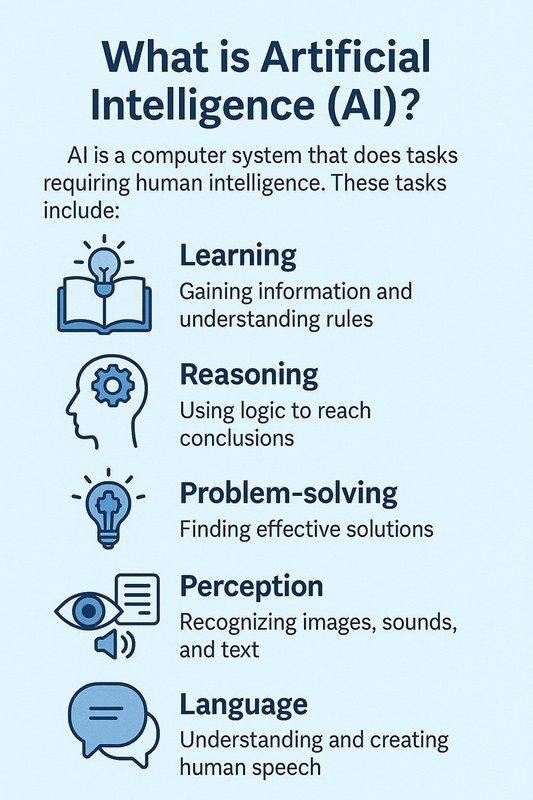
What Is Artificial Intelligence in Simple Words Explained
Artificial intelligence is software that learns from data to recognize patterns and make predictions or decisions. It powers the voice assistants, recommendations, and smart features you use every day, but it does not think or feel like a human.
If you have ever wondered what is artificial intelligence in simple words, you are not alone — and the answer is easier to grasp than most headlines suggest. AI has moved from science-fiction plots into everyday tools, but the way it actually works is far less mysterious than people assume.
- Simple definition: AI is software that learns from data to recognize patterns and make predictions.
- How it works: AI finds patterns in large numbers of examples instead of following fixed rules.
- Main types: Narrow AI powers today’s tools; general and superintelligent AI remain future goals.
- Real benefits: Speed, consistency, scalability, and personalization at a level humans cannot match.
- Key limits: AI can be biased, make confident mistakes, and lacks common sense and true understanding.
What Is Artificial Intelligence in Simple Words?
At its core, artificial intelligence is a branch of computer science that builds software capable of performing tasks that normally require human intelligence. Those tasks include understanding language, recognizing images, making decisions, and solving problems.
The word “intelligence” is where things get confusing. An AI system does not think, feel, or understand the way a person does. Instead, it processes enormous amounts of information, finds patterns, and uses those patterns to make predictions or decisions. That is why a photo app can recognize your friend’s face, why your email provider filters spam, and why a streaming service seems to know exactly which shows you will enjoy.
How Does Artificial Intelligence Actually Work?
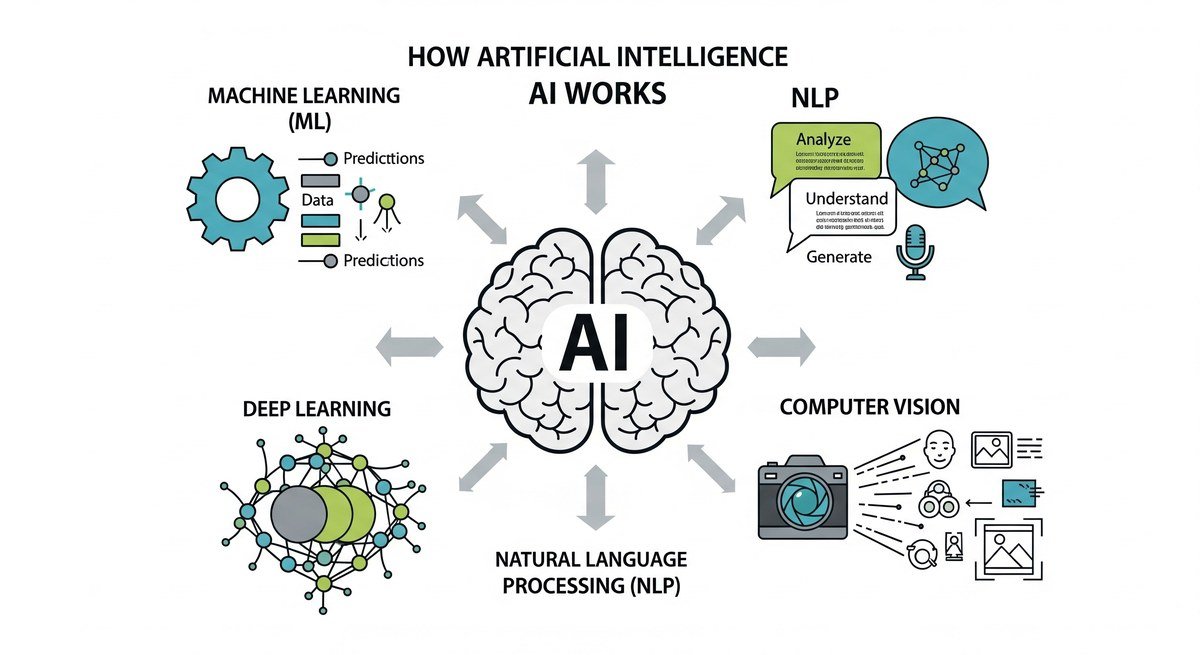
A neural network diagram illustrating data flowing through processing layers to produce an output.
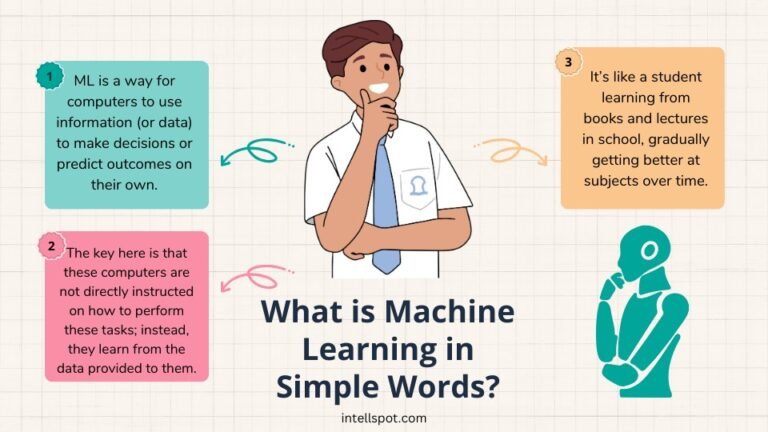
Most modern AI is built on a process called machine learning. Instead of being programmed with a fixed rule for every situation, an AI system is shown thousands or millions of examples and adjusts its internal calculations until it can handle the task on its own.
Learning From Data and Examples
Think of it like teaching a child to recognize a dog. You do not hand them a dictionary definition; you point at dogs again and again until they absorb the pattern. AI does the same thing, except it processes far more examples in a fraction of the time a human could. The quality of the results depends heavily on the quality of the data — messy data produces messy behavior.
Recognizing Patterns and Making Predictions
Once an AI system has learned from data, its main job is pattern recognition and prediction. When you type part of a sentence, your phone predicts the next word. When a bank reviews a transaction, its AI predicts whether the activity looks fraudulent. When a streaming service suggests a movie, it is predicting what you are likely to watch next.
This is not the same as reasoning. The AI compares new information against the patterns it learned and chooses the most likely answer. That distinction matters because it explains both what AI does well and where it falls short.
When you hear that an AI system is “thinking,” translate it as “matching patterns in data.” That simple mental shift makes AI far easier to understand and far less intimidating.
The Main Types of AI You Should Know
Not all AI is the same. In fact, the gap between the AI we have and the AI in movies is enormous. Understanding the three main categories helps you make sense of news headlines and product claims.
Narrow AI: The One We Use Every Day
Narrow AI, sometimes called weak AI, is designed to do one specific task — and it does that task very well. Your voice assistant, your spam filter, your navigation app, and your photo-editing tools all rely on narrow AI. It cannot suddenly write a novel, drive a car, or plan a vacation unless it was specifically built and trained for that job.
General AI: The Long-Term Goal
General AI, also called artificial general intelligence (AGI), would be a system capable of learning and performing any intellectual task that a human can. It would adapt to new situations without special training, reason across different fields, and understand context the way people do. AGI does not exist yet, and researchers disagree about how far away it might be. Every AI tool you use today is narrow AI.
Superintelligent AI: Science Fiction or Future Reality?
Superintelligent AI would surpass human intelligence in every way — creativity, problem-solving, social reasoning, and more. This is the AI of movies like “2001: A Space Odyssey” or “Ex Machina.” It is a subject of serious philosophical debate, but it is currently a theoretical concept, not a technology anyone has built.
The term “artificial intelligence” was coined in 1956 at the Dartmouth Summer Research Project, a workshop where researchers first gathered to explore whether machines could simulate human intelligence.
Everyday Examples of AI in 2026
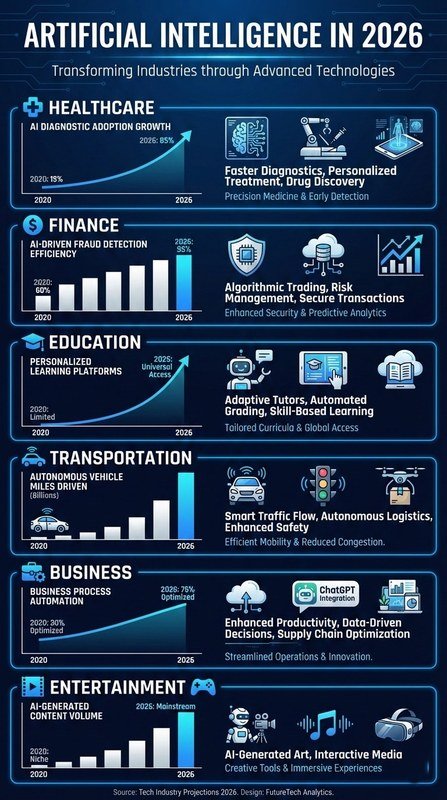
Smart speaker, smartphone assistant, and autonomous vehicle represent common AI tools in daily life.
By 2026, AI is so embedded in everyday apps that most people use it dozens of times a day without noticing. You do not need a robot or a futuristic gadget to encounter AI — it is already in the devices you own.
AI in Your Smartphone and Apps
Your phone’s face unlock, predictive keyboard, photo search, and map routing all depend on AI. Streaming services use it to decide what to show you next, shopping apps use it to surface products you are likely to buy, and email apps use it to sort your inbox and suggest quick replies.
AI at Home: Smart Speakers and Assistants
Smart speakers and home assistants are the most visible AI in many households. They answer questions, set timers, control lights, and play music in response to voice commands. Under the surface, they combine speech recognition, natural-language processing, and machine learning — several narrow AI systems working together.
AI at Work and in Healthcare
At work, AI helps with email sorting, meeting transcription, document summaries, and customer-service chatbots. In healthcare, AI systems assist doctors by flagging suspicious areas in medical scans, predicting patient risk, and speeding up administrative tasks. These tools support professionals rather than replace them, but they are changing how quickly and accurately work gets done.
AI features vary widely by device, app, and subscription plan. A voice assistant on one phone may not offer the same capabilities as the same assistant on another device, so check the specific product documentation for what your setup actually supports.
The Benefits of Artificial Intelligence
The reason AI has spread so quickly is simple: it delivers real, measurable value across almost every field. Here are the benefits that matter most.
Speed, Efficiency, and 24/7 Availability
AI never sleeps. It processes data, answers questions, and completes routine tasks around the clock without breaks, vacations, or slowdowns. That makes it invaluable for customer support, data analysis, and any operation where speed matters.
Consistency and Scalability
Once an AI system is trained, it applies the same standards to every task. It does not get tired, distracted, or inconsistent. It can also handle workloads that would overwhelm a human team — sorting millions of documents, reviewing thousands of images, or monitoring live data streams without losing focus.
Personalization at Scale
AI makes it possible to personalize experiences for millions of people at once. Every streaming recommendation, targeted ad, and product suggestion is a form of personalization that would be impossible to do manually. The trade-off is that personalization depends on data, which raises privacy questions worth paying attention to.
The Limitations and Risks of AI
AI is powerful, but it is not perfect. Understanding its limits is just as important as understanding its capabilities, especially as it takes on more responsibilities.
Bias in the Training Data
AI learns from data, and data reflects the real world — including its biases. If a system is trained on historical hiring records, it may learn patterns that disadvantage certain groups. Bias is not a glitch; it is a consequence of the data the AI was shown, and it requires careful oversight to address.
Job Displacement Concerns
AI can automate routine tasks, and that naturally raises concerns about jobs. Some roles will change, some tasks will be automated, and new kinds of work will emerge. History suggests that technology shifts the job market rather than simply erasing it, but the transition can be difficult for workers in affected fields.
Why AI Still Lacks Common Sense
For all its power, AI has no real understanding of the world. It can generate a fluent paragraph about a topic it knows nothing about, and it can confidently state something completely false. This is often called the hallucination problem, and it is why AI output should always be reviewed by a human before it is trusted.
Common Misconceptions About AI
Because AI is surrounded by hype and science fiction, several misconceptions have taken root. Clearing them up makes the technology much easier to use wisely.
AI Is Not Conscious or Self-Aware
Despite the language used to describe it, AI is not conscious. It has no feelings, no desires, and no awareness of itself. When a chatbot says it is “happy to help,” it is generating a plausible response, not experiencing an emotion. Confusing performance with consciousness leads to unrealistic expectations — and unnecessary fear.
AI Won’t Replace Every Human Job
The idea that AI will eliminate all jobs is one of the most common fears, and it is not supported by how the technology actually works. AI excels at specific, repeatable tasks. Jobs that require judgment, empathy, physical presence, creativity, and human connection remain firmly human. What is more likely is that many roles will change as AI becomes a tool within them.
You Don’t Need to Be a Tech Expert to Use AI
One of the biggest changes in recent years is how accessible AI has become. You do not need to understand machine learning to use a voice assistant, ask a chatbot for help, or have your phone organize your photos. The barrier to entry is curiosity, not a computer science degree.
- Treat AI as a helpful assistant that can make mistakes, and verify important facts before relying on them.
- Keep a human in the loop for decisions that affect your health, money, or legal rights.
- Avoid assuming AI output is always correct just because it sounds confident.
- Avoid sharing sensitive personal information with AI tools before checking their privacy policies.
The Future of AI and Final Thoughts
AI will keep evolving, and the pace of change shows no sign of slowing. The good news is that you do not need to predict the future to prepare for it — you just need a clear understanding of the basics.
What to Expect in the Next Few Years
Expect more AI features built directly into the tools you already own — your phone, your browser, and your workplace software. Expect better voice interaction, smarter assistants, and more personalized experiences. Expect regulation and public debate to grow alongside the technology, especially around privacy, bias, and accountability.
Why Understanding AI Matters Now
Understanding AI is no longer a technical curiosity; it is a life skill. The more you understand what AI can and cannot do, the better you can use it productively, spot its mistakes, protect your privacy, and make informed decisions about the technology shaping your daily life. You do not need to become an expert — you just need a clear mental model.
- AI is software that learns from data to recognize patterns and make predictions.
- Every AI tool in use today is narrow AI, designed for specific tasks.
- AI offers speed, consistency, and personalization, but it also carries risks like bias and confident mistakes.
- AI is not conscious, and it will not replace every human job.
- The best approach is to use AI as a capable assistant while verifying its output.
Frequently Asked Questions




6 Comments