What is Semantic Search in Simple Words Easy Explanation
The short answer is that semantic search understands the meaning and intent behind your query, not just the exact words you type. It connects what you ask with the information you actually want, even when the wording is completely different.
The short answer to what is semantic search in simple words is this: it’s a search technology that understands the meaning behind your query instead of just matching the exact words you typed. Rather than treating a search like a word-for-word matching game, semantic search looks at intent, context, and the relationships between concepts to deliver results that actually answer your question.
If you’ve ever typed something into Google in a casual, conversational way and still found exactly what you needed, you’ve already used semantic search. It’s the reason search engines can understand “how to fix a noisy fridge” even when the best guide on the web is titled “Quieting a Loud Refrigerator.” In this guide, we’ll break down how semantic search works, how it’s different from traditional keyword search, and what it means for you as a regular internet user.
- Definition: Semantic search understands meaning and intent, not just exact words.
- How it works: It uses vectors, embeddings, and natural language processing to connect concepts.
- Key difference: Keyword search matches text; semantic search matches meaning.
- Daily use: Google, voice assistants, shopping sites, and streaming services all rely on it.
- Action step: Ask full, natural questions and create content that genuinely answers queries.
What Is Semantic Search? A Simple, No-Jargon Definition
Semantic search is a type of search that tries to understand the meaning and intent behind a query rather than just looking for exact word matches. The word “semantic” comes from linguistics and refers to meaning, so semantic search literally means “search that understands meaning.”
Think about the difference between two ways of finding information. Keyword search is like flipping through a dictionary looking for a specific word; if the word isn’t there, you’re out of luck. Semantic search is like asking a knowledgeable friend a question. Even if you phrase things imperfectly, your friend understands what you mean and points you in the right direction.
For example, if you search “how to make my phone battery last longer,” a keyword-only system might look for pages containing those exact words. A semantic search system understands that you’re looking for battery-saving tips, and it can surface articles titled “Extend Your Smartphone Battery Life” even though they use different wording.
How Semantic Search Works: The Core Ideas Behind the Magic
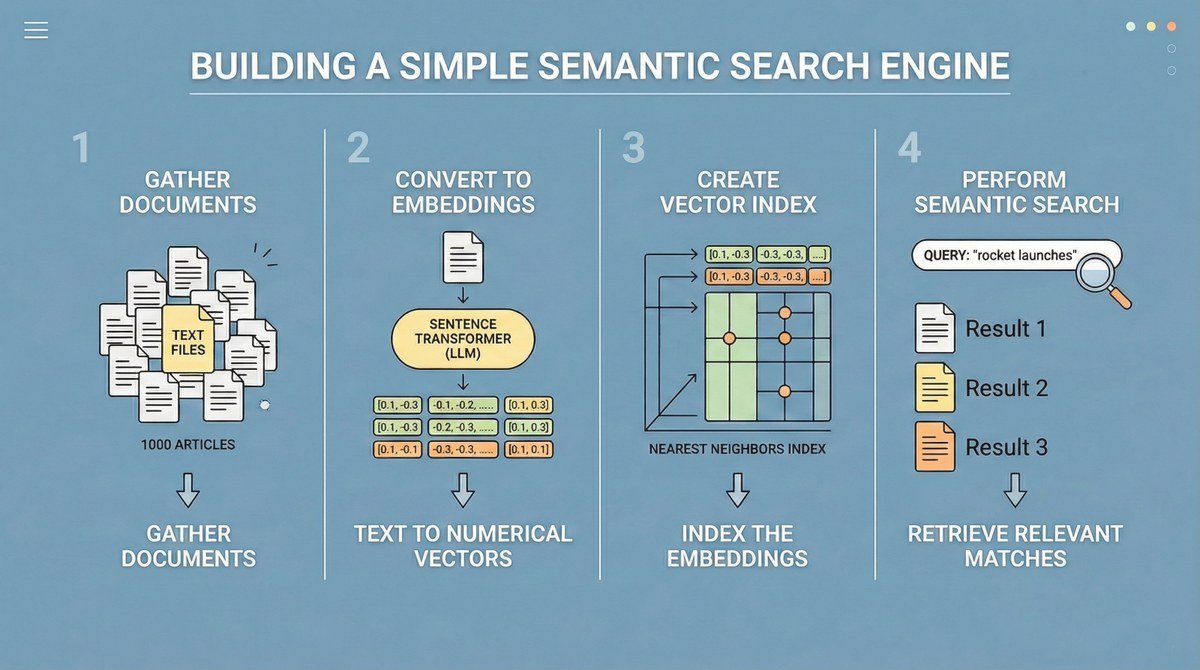
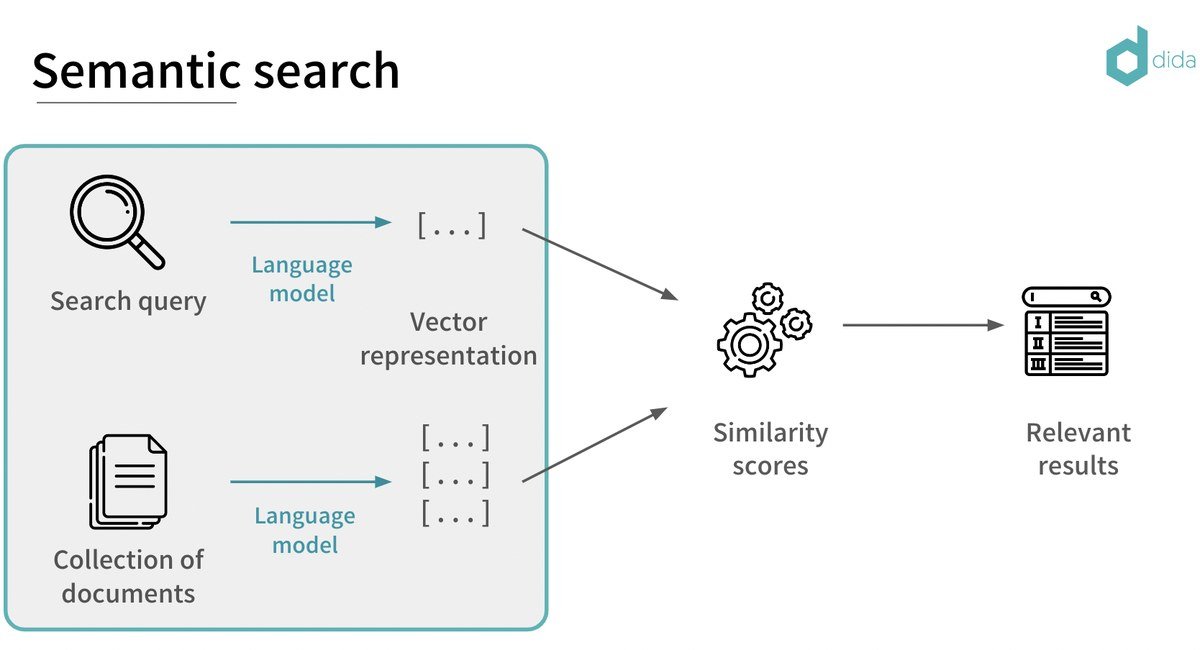
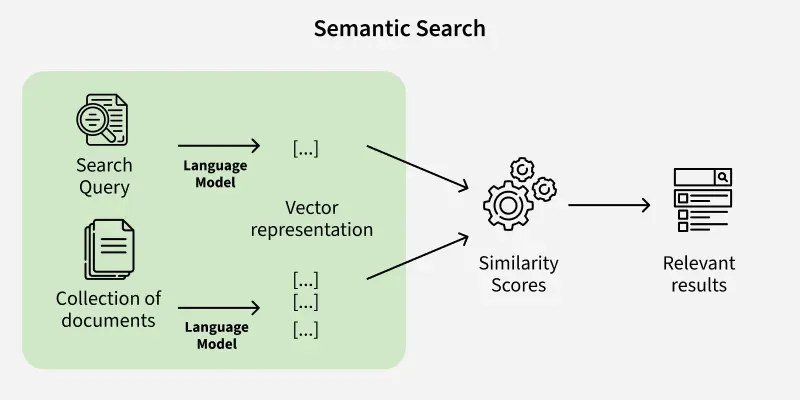
Semantic search uses AI to understand intent and meaning behind words, returning relevant results.
Semantic search sounds almost like magic, but it’s built on a few straightforward ideas from artificial intelligence and computer science. Two of the most important are vectors and embeddings, and natural language processing.
Vectors and Embeddings: How Computers Understand Meaning
Computers don’t understand words the way humans do. They work with numbers. So to help a computer understand meaning, search systems convert words into long lists of numbers called vectors. This process is called embedding.
Here’s the clever part: words with similar meanings end up with similar numbers. In this mathematical space, “happy” sits close to “joyful,” while “sad” sits far away. Even better, relationships between words can be captured. The system can learn that “king” is to “queen” as “man” is to “woman,” because the mathematical distance between those pairs is similar.
This is the same technology that powers large language models like the AI behind ChatGPT. These models learn patterns from enormous amounts of text, and those patterns become the “understanding” that makes semantic search possible.
The idea of matching meaning rather than just text has roots in information retrieval research from the 1960s, long before the internet existed.
Natural Language Processing: Teaching Machines to Read Context
Vectors handle word meaning, but natural language processing (NLP) handles how words work together in sentences. NLP is the branch of AI that helps computers understand, interpret, and respond to human language.
NLP helps search systems handle things like:
- Synonyms: knowing that “automobile” and “car” mean the same thing
- Word order: understanding that “dog bites man” and “man bites dog” are very different events
- Context: recognizing that “bank” means something different in “river bank” versus “savings bank”
- Intent: figuring out whether “best pizza near me” is a request for recommendations or directions
Together, vectors and NLP let search engines go beyond matching words. They match concepts.
Semantic Search vs. Keyword Search: What’s the Real Difference?
The simplest way to understand semantic search is to compare it with what came before. Traditional keyword search dominated the early internet, and it’s still used in many databases and basic site search tools.
| Feature | Keyword Search | Semantic Search |
|---|---|---|
| Matches exact words | Yes | Not required |
| Understands synonyms | No | Yes |
| Understands intent | No | Yes |
| Handles typos and phrasing | Poorly | Well |
| Learns from context | No | Yes |
| Example query | “cheap flights new york” | “How can I find affordable flights to New York?” |
Keyword search is fast and predictable, but it’s rigid. If you search “affordable vacation spots” and a great article is titled “Budget-Friendly Places to Travel,” a keyword system might miss it entirely. Semantic search connects the two because it understands that “affordable,” “budget-friendly,” “vacation,” and “travel” point to the same idea.
Everyday Examples of Semantic Search You’ve Already Used<
A hand holding a smartphone displaying search suggestions that interpret user intent.
A hand holding a smartphone displaying search suggestions that interpret user intent.
You probably use semantic search dozens of times a day without realizing it. Here are some of the most common places it shows up:
Google and other search engines. When you type a full question like “why is my internet so slow at night,” Google understands you want troubleshooting advice, not a definition of slow internet. The results often include articles with completely different wording, because the search engine matched the meaning, not the exact phrase.
Voice assistants. When you ask Siri, Alexa, or Google Assistant “what’s the weather like tomorrow?” the assistant has to understand the meaning of your question, figure out your location, and convert your spoken words into an action. That’s semantic search in action.
Shopping websites. When you search “comfy office chair” on an e-commerce site, the best results aren’t limited to products with “comfy” in the title. The system understands you want an ergonomic or comfortable chair and adjusts accordingly.
Streaming services. When you type “funny movies for a rainy day” into Netflix or YouTube, the recommendation engine interprets the mood and intent behind your request. These platforms use similar AI techniques to suggest content you’ll actually enjoy.
These are all examples of AI search in practice, where the system goes beyond matching text to understanding what you’re really looking for.
Who Benefits Most from Semantic Search in 2026?
By 2026, semantic search has become the default for most major platforms. It’s not a futuristic feature anymore; it’s the foundation of how we find information online. That shift affects everyone, but two groups benefit most.
Everyday Users: Smarter Results, Less Effort
For regular users, the biggest win is that you no longer need to think like a search engine. You can type questions the way you’d ask a friend: “What’s the best way to remove red wine from a carpet?” or “How do I know if my tires need replacing?” The search engine does the heavy lifting of figuring out what you mean.
This is especially helpful for people who aren’t tech-savvy. Older users, kids, and anyone who struggles with finding the right keywords can now get useful results simply by describing what they need in normal language.
Businesses and Content Creators: Reaching the Right Audience
For businesses, bloggers, and content creators, semantic search has changed the rules of visibility. The old strategy of stuffing articles with exact-match keywords is dead. Search engines now reward content that genuinely answers questions and covers topics in depth.
This is good news for smaller creators. You no longer need to compete for the exact same keyword phrase as a giant corporation. If you write a clear, helpful article that answers a real question, semantic search can connect you with the people who need that information, even if they phrase their search differently than your headline.
Key Benefits, Limitations, and Common Mistakes to Avoid
The Biggest Advantages of Semantic Search
- Understands natural language and full questions
- Handles synonyms, typos, and phrasing differences
- Delivers more relevant results for complex queries
- Improves over time as it learns from user behavior
- Can misunderstand ambiguous or vague queries
- Depends heavily on the quality of training data
- May struggle with niche, technical, or local topics
- Requires significant computing power to run
Where Semantic Search Falls Short
Semantic search is powerful, but it’s not infallible. Ambiguity is a real problem. If you search “jaguar speed,” the system has to guess whether you mean the animal, the car brand, or the operating system. Usually it uses your search history and location to make a guess, but sometimes it guesses wrong.
Another limitation is that semantic search is only as good as the data it was trained on. If the training data contains biases or gaps, those flaws can show up in search results. This is one reason AI reasoning is such an active area of research; getting a machine to truly reason about meaning is much harder than getting it to recognize patterns.
Finally, semantic search can struggle with highly specialized topics. A medical researcher searching for a precise technical term might actually get better results from a traditional keyword search in a specialized database than from a general semantic search engine.
Common Misconceptions and Mistakes Users Make
Misconception: Semantic search reads my mind. It doesn’t. It makes educated guesses based on patterns in language and your past behavior. If your query is vague, the results can be off.
Misconception: It’s just about synonyms. Synonyms are part of it, but semantic search also understands relationships, context, and intent. It’s a much bigger idea than simply swapping one word for another.
Misconception: SEO is dead. Search engine optimization isn’t dead, but it has changed. The mistake is still writing content for algorithms instead of people. The best way to rank well in a semantic search world is to write clear, genuinely useful content that answers real questions.
How to Get the Most Out of Semantic Search: Practical Tips
Here are practical tips for both searchers and content creators:
- For searchers: Use conversational, natural language and include context like your location, skill level, or budget.
- For searchers: If your first search doesn’t work, rephrase it as a question rather than adding more keywords.
- For content creators: Write for humans first. Answer the question clearly in the first paragraph, then add supporting detail.
- For content creators: Use related terms and natural variations of your topic instead of repeating the same keyword over and over.
- For everyone: Be specific. “Best budget laptop for college students” gives the search engine far more useful context than “best laptop.”
Final Verdict: Why Understanding Semantic Search Matters
Semantic search isn’t just a technical detail; it’s the reason the internet feels smarter than it did a decade ago. It’s why you can type a rambling question into a search bar and still find the perfect answer. It’s why voice assistants make sense when you speak to them casually. And it’s why businesses now have to focus on being genuinely helpful instead of just repeating keywords.
Understanding semantic search matters because it changes how you should approach both searching and creating content. As a searcher, you get better results when you ask clear, complete questions. As a content creator or business owner, you reach more people when you write content that truly answers their needs.
- Semantic search understands meaning and intent, not just exact words.
- It works through vectors, embeddings, and natural language processing.
- It differs from keyword search by handling synonyms, context, and full questions.
- You already use it daily in Google, voice assistants, shopping sites, and streaming apps.
- To benefit, ask natural questions and create content that genuinely helps people.
The bottom line: semantic search is one of the most important AI technologies you interact with every day, and you don’t need a computer science degree to use it well. Just speak naturally, ask real questions, and expect the search engine to meet you halfway.
Frequently Asked Questions