The Secret Behind How Chatbots Understand Human Language
Chatbots understand language by converting your words into numbers, analyzing patterns learned from massive text datasets, and predicting the most likely next word. That statistical prediction creates the appearance of understanding, but it has real limits — chatbots can still hallucinate, miss context, and produce confident errors.
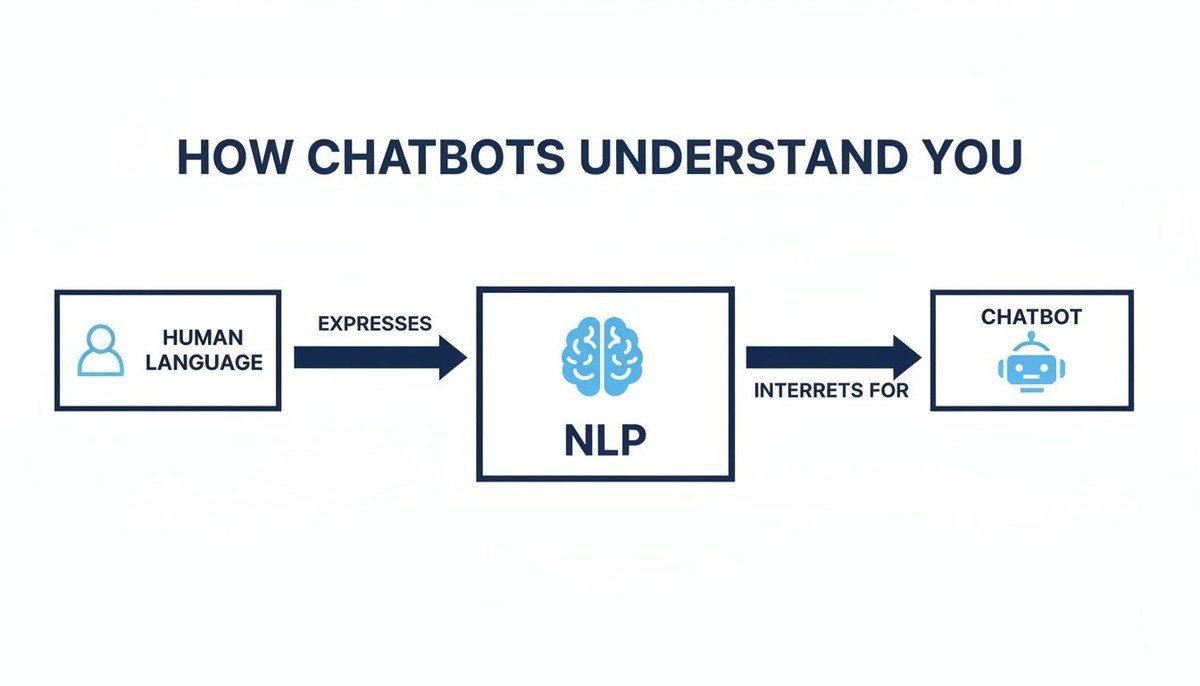
Few topics in modern tech raise as many questions as how chatbots understand human language — and the answer is both simpler and stranger than most people expect. When you type a question into a chatbot, the machine isn’t reading your words the way a person would. It’s converting your sentence into numbers, comparing those numbers against patterns learned from billions of examples, and generating a reply one small piece at a time.
- Prediction, not comprehension: Chatbots predict the most likely next word; understanding is an emergent effect of that.
- Three pillars: NLP, NLU, and NLG work together to parse, interpret, and generate language.
- Transformers and attention: These let models track meaning and context across long prompts.
- Training matters: Pre-training, fine-tuning, and RLHF shape how helpful and aligned a chatbot is.
- Verify before trusting: Hallucinations, bias, and missing common sense remain real limitations in 2026.
What Does It Mean for a Chatbot to “Understand” You?
When humans say we understand a sentence, we mean we grasp its meaning, intent, tone, and context. We know that “Can you open the window?” is a request, not a question about physical ability. Chatbots have no such conscious grasp. Instead, they build statistical models of language: which words tend to follow which words, which phrases cluster around which topics, and which responses are most likely to satisfy a given prompt.
That distinction matters because it changes how you should interpret a chatbot’s output. A chatbot that “understands” your question in the statistical sense can still miss sarcasm, ignore an unspoken assumption, or confidently answer a question it has no real knowledge of.
Understanding vs. Predicting: The Core Distinction
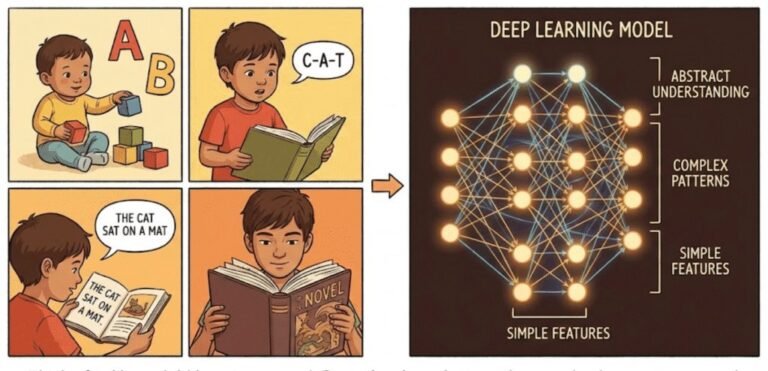
At its core, a modern chatbot is a prediction engine. Given a sequence of words, it predicts the most likely next word — then the next, then the next — until a complete response emerges. This is called next-token prediction, and it sounds too simple to produce useful conversation. Yet when a model is trained on enormous amounts of text, the predictions force it to learn a great deal about grammar, facts, reasoning patterns, and even style.
The “understanding” you experience is an emergent property of that prediction process. The model doesn’t consult a database of facts; it reconstructs plausible knowledge from patterns. That’s why chatbots can be brilliant at summarizing, brainstorming, and explaining — and why they can also be utterly wrong with total confidence.
The Three Pillars: NLP, NLU, and NLG
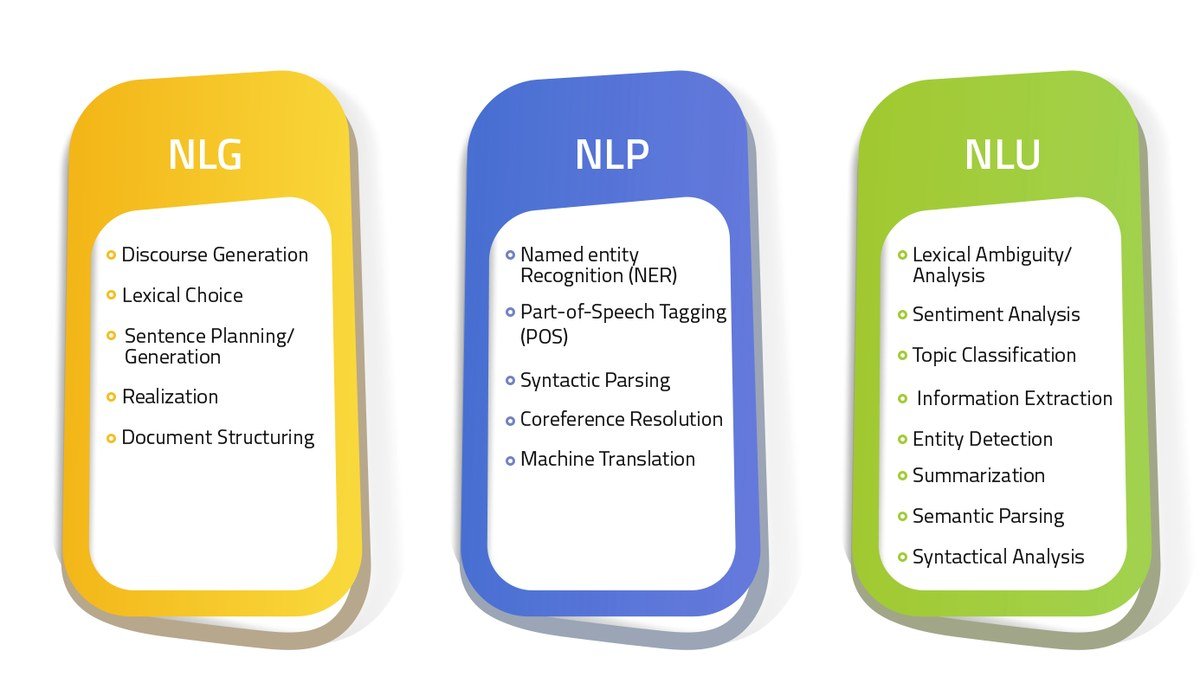
Diagram showing how NLP, NLU, and NLG work together in chatbot language processing.
To make sense of how chatbots understand human language, it helps to know the three fields that work together behind the scenes. They’re often lumped together, but each plays a distinct role.
How Each Pillar Contributes to Conversation
Natural Language Processing (NLP) is the umbrella discipline — the entire field of teaching computers to work with human language. Natural Language Understanding (NLU) is the part that extracts meaning from your input: it identifies the intent (“the user wants a recipe”), pulls out entities (“chicken,” “slow cooker”), and detects sentiment. Natural Language Generation (NLG) is the opposite side: it turns structured information into fluent, readable sentences.
In a typical exchange, NLU parses your question, the underlying model processes it, and NLG produces the reply. Understanding this pipeline helps explain why chatbots sometimes misunderstand you: if the NLU step misreads your intent, everything downstream goes off the rails. For a deeper look at the technology that powers these systems, see our explainer on how generative AI works.
Inside the Engine: How Large Language Models Decode Your Words
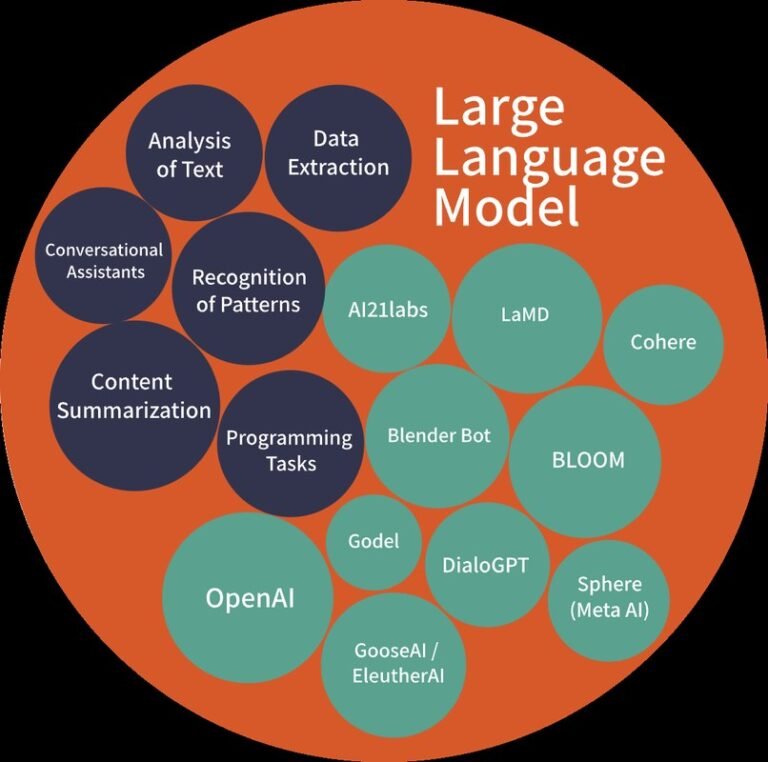
Most modern chatbots run on large language models (LLMs) built on a neural network architecture called the Transformer. To understand how chatbots understand human language at a technical level, you need to know two steps: tokenization and embeddings, followed by the attention mechanism.
Tokenization and Embeddings
Before a model can process text, it must break your sentence into tokens — chunks that can be whole words, parts of words, or even single characters. “Chatbots” might become [“Chat,” “bots”] or [“Chatbots”], depending on the model’s vocabulary. Each token is then converted into an embedding: a long list of numbers (a vector) that captures the token’s meaning in a high-dimensional space.
These embeddings are the heart of the system. Words with similar meanings end up with similar vectors, which is why a model can understand that “happy” and “joyful” are related without being told explicitly. The model doesn’t see letters; it sees coordinates in a mathematical map of meaning.
The Transformer and Attention Mechanism
Once your words are embeddings, the Transformer processes them all at once rather than one at a time. The key innovation is the attention mechanism, which lets the model weigh how much each word should influence every other word. In the sentence “The bank raised its interest rates,” attention helps the model connect “bank” to “interest rates” and interpret it as a financial institution, not a riverbank.
This ability to track relationships across long stretches of text is what separates modern chatbots from older keyword-matching systems. Attention is also why context matters so much: the same word can mean different things depending on what surrounds it.
The Transformer architecture was introduced in a 2017 research paper titled “Attention Is All You Need.” It replaced older sequence-based models and became the foundation for nearly every major chatbot and language model released since.
From Raw Data to Conversational AI: The Training Journey<
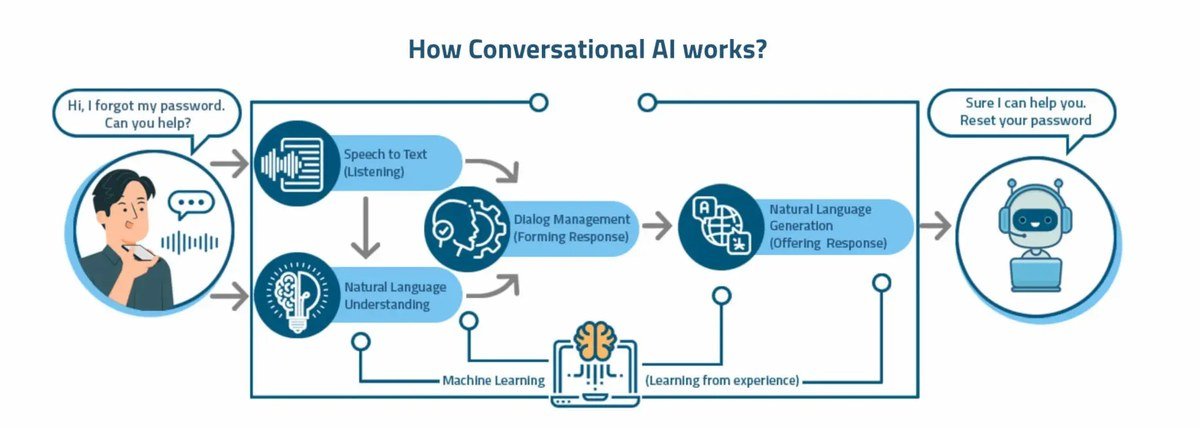
Training process transforms raw text data into conversational AI.
Training process transforms raw text data into conversational AI.
A chatbot isn’t programmed with rules; it’s trained on data. The journey from raw text to conversational assistant happens in stages, each with a different goal.
Pre-Training and Fine-Tuning
In pre-training, the model reads an enormous corpus of text — books, articles, websites, and code — and learns to predict the next token. This stage builds the model’s general knowledge of language and the world. But a raw pre-trained model isn’t great at conversation; it just completes text. Fine-tuning fixes that by training the model on curated examples of instructions and ideal responses, teaching it the format of a helpful answer.
If you’re new to the underlying concepts, our beginner-friendly guide to how artificial intelligence works for beginners walks through the basics of neural networks and training data.
RLHF: Aligning AI with Human Preferences
The final major step is Reinforcement Learning from Human Feedback, or RLHF. Human raters compare multiple chatbot responses to the same prompt and rank them by helpfulness, accuracy, and tone. The model then learns to favor the responses humans preferred. RLHF is the reason modern chatbots sound conversational and refuse harmful requests — it’s a layer of human judgment on top of raw statistical prediction.
Why Chatbots Still Get It Wrong
Despite all this sophistication, chatbots fail in predictable ways. Knowing these failure modes helps you decide when to trust an answer and when to double-check it.
Hallucinations and Confident Errors
A hallucination is a response that sounds fluent and plausible but is factually wrong. Because the model generates text by predicting likely words rather than retrieving verified facts, it can invent statistics, cite nonexistent studies, or describe events that never happened. The most dangerous part is the confidence: a hallucinated answer often reads exactly like a correct one.
The Common Sense and Bias Gaps
Chatbots also lack embodied common sense. They’ve never felt heat, held an object, or watched physical cause and effect unfold — they only read about those experiences. That gap shows up in odd ways, like a model confidently suggesting an unsafe solution to a practical problem. Bias is another issue: models learn from human-written text, which means they absorb the prejudices, stereotypes, and blind spots present in that text. Training teams work to reduce these biases, but they can’t eliminate them entirely.
The 2026 State of Chatbots: Memory, Multimodality, and Agentic AI
By 2026, the chatbot landscape looks very different from the simple text boxes of a few years ago. Three developments stand out.
Multimodal Understanding
Modern chatbots can process more than text. You can upload a photo of a plant and ask why its leaves are yellow, share a screenshot and request a summary, or record audio and get a transcript. Multimodal models combine vision, audio, and text into a single system, so the same “understanding” mechanism now applies across different types of input.
Long-Term Memory and Personalization
Many 2026 chatbots can remember details across sessions — your preferences, past projects, ongoing goals. This makes conversations feel more continuous and useful, but it also raises privacy questions. Memory settings, data deletion controls, and transparency about what’s stored now vary significantly by product.
Memory and personalization features vary by model and platform. Before sharing sensitive information with any chatbot, check its privacy policy and review the data controls in your account settings.
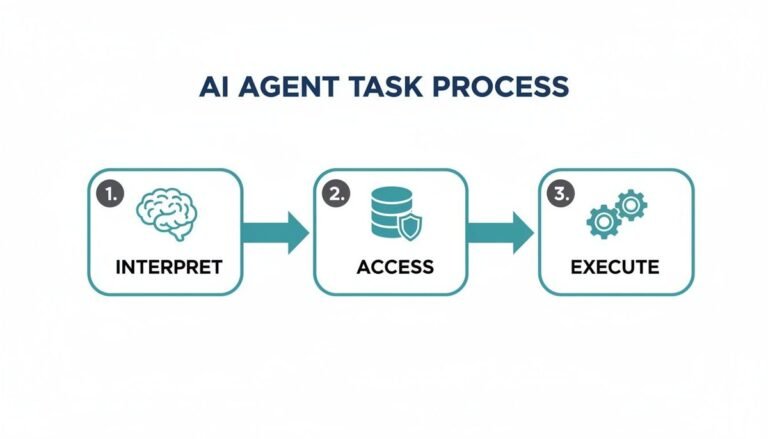
The most ambitious systems are becoming agentic — they don’t just answer questions; they take actions like booking appointments, writing code, or navigating websites on your behalf. If you want to understand where this is heading, our breakdown of how AI agents work step by step covers the mechanics.
How to Talk to a Chatbot: Practical Prompting Tips
Getting a good answer from a chatbot is partly a skill. The same model can produce a vague, generic response or a sharp, detailed one depending on how you phrase your request.
Give Context and Iterate
Start with the key details: who the answer is for, what you’ll use it for, and any constraints. Instead of “Write an email,” try “Write a polite email to my landlord explaining that the dishwasher has been broken for two weeks and asking for a repair date.” Then treat the first response as a draft — point out what’s missing and ask for revisions.
Ask the chatbot to adopt a role (“You are a patient tutor”), specify a format (“Give me a numbered list with one-sentence explanations”), and request sources (“Only include facts you can support”). These three moves consistently improve response quality.
What to Look For in a 2026 Chatbot
Not all chatbots are created equal. When choosing one for regular use, consider these features:
- Tool use: Can it search the web, run calculations, or execute code? Tool-equipped models can verify facts instead of relying purely on memory.
- Source citations: Does it show where information comes from? Citations make it easier to spot hallucinations.
- Memory controls: Can you view, export, or delete what the chatbot remembers about you?
- Multimodal input: Can you upload images, PDFs, or audio when you need to?
- Transparency: Does the provider clearly explain limitations and update notes?
The Final Verdict: Should You Trust a Chatbot’s “Understanding”?
Chatbots understand language well enough to be genuinely useful, but not well enough to be treated as an infallible authority. The right approach is to use them as a capable assistant with a supervisor — you.
Who Should Rely on Chatbot Understanding
Chatbots are excellent for brainstorming ideas, drafting and editing text, summarizing long documents, explaining concepts, and helping with coding. They’re risky for anything where a wrong answer causes real harm: medical advice, legal conclusions, financial decisions, or any factual claim you can’t verify. For those, treat the chatbot’s answer as a starting point, not a final word.
| Use Case | Trust Level | Why |
|---|---|---|
| Brainstorming and drafting | High | Low stakes; errors are easy to spot and fix |
| Summarizing and explaining | Medium-High | Useful, but check key facts against the source |
| Coding help | Medium | Test the code; it may contain subtle bugs |
| Medical, legal, or financial advice | Low | Hallucinations can sound authoritative; consult a professional |
As AI becomes more woven into daily routines, knowing how chatbots understand human language — and where that understanding breaks down — is the difference between using these tools wisely and being misled by them. For more on how these systems shape ordinary life, explore how AI is changing everyday life.
- Chatbots predict the next word using statistical patterns; “understanding” is an emergent effect, not conscious comprehension.
- Tokenization, embeddings, and the Transformer’s attention mechanism let models track meaning and context across long prompts.
- Pre-training, fine-tuning, and RLHF turn raw text data into a helpful, aligned conversational assistant.
- Hallucinations, bias, and missing common sense remain real limitations — always verify high-stakes answers.
- In 2026, multimodal input, long-term memory, and agentic actions make chatbots more capable and more deserving of careful oversight.
Frequently Asked Questions