How AI Can Affect Personal Privacy and Why It Matters
AI affects personal privacy by harvesting data, inferring sensitive details, and making automated decisions without clear consent. Understanding these risks helps you take control of what you share and how it’s used.
Understanding how ai can affect personal privacy has become essential for anyone who uses connected devices, online services, or AI-powered tools. Artificial intelligence now shapes everything from search results and credit scores to health recommendations and home security, and each of those systems depends on personal data to function. The convenience is real, but so are the risks: surveillance, profiling, and automated decisions that can change your opportunities without your knowledge. This guide breaks down the core privacy threats, who is most exposed, and what you can actually do to protect yourself.
- Continuous data harvesting: AI systems collect location, browsing, and device data across platforms, often without active awareness.
- Silent profiling: AI can infer income, health, and beliefs from seemingly harmless behavior patterns.
- High-stakes automation: Algorithms influence credit, insurance, housing, and hiring decisions with little transparency.
- Uneven risks: Children, marginalized groups, and high-profile individuals face elevated privacy threats.
- Practical protection: Privacy settings, local processing, encryption, and stronger regulations all help.
How AI Can Affect Personal Privacy: The Core Answers
Direct Surveillance and Data Harvesting
The most straightforward way AI affects privacy is through direct data collection. Every app that tracks your location, every website that records your clicks, and every smart device that logs your usage is harvesting information that can be stored, analyzed, and shared. Unlike traditional tracking, AI-powered systems are designed to collect continuously across multiple platforms, building a detailed timeline of your habits, routines, and preferences.
This data is often combined with information from other sources—purchase histories, social media activity, and even public records—to create a far more complete picture than any single platform could assemble on its own. The result is that your digital footprint becomes a commodity, traded and analyzed in ways that are rarely transparent.
Inferred Data and Profiling
AI doesn’t just collect what you do; it draws conclusions about who you are. By analyzing patterns in your behavior, AI systems can infer your approximate income, education level, political leanings, health conditions, and even emotional state. These inferences are often based on data you never directly shared, such as the time you spend reading certain articles, the vocabulary you use in messages, or the neighborhoods you visit.
Profiling of this kind is especially concerning because it operates silently. You may never see the profile a company has built about you, yet that profile can influence the ads you see, the prices you’re offered, and the opportunities you encounter.
Automated Decision-Making and Its Consequences
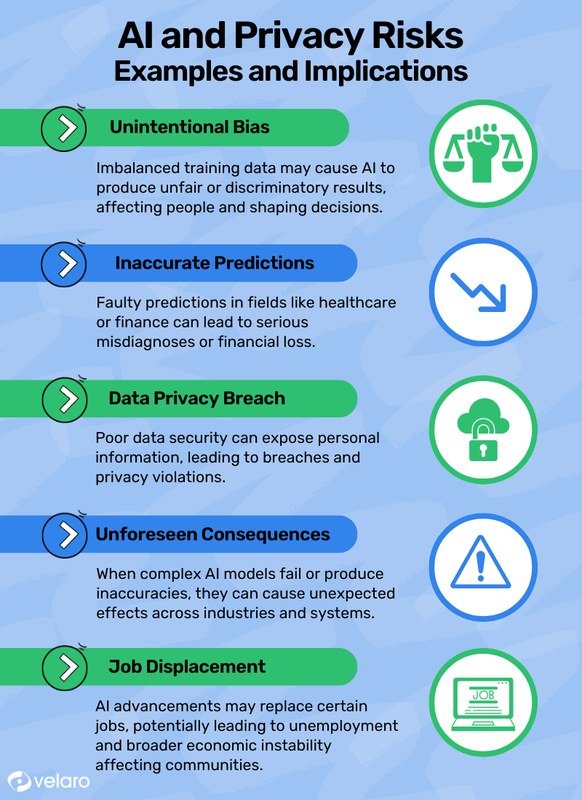
When AI uses your data to make decisions, the stakes rise significantly. Loan applications, rental approvals, insurance premiums, and even job screening increasingly rely on algorithmic models that weigh hundreds of data points. If a model decides you’re a risk based on an incorrect inference or a biased dataset, you may never know why you were rejected.
These systems are often protected as proprietary, which means individuals have limited ability to challenge their outcomes. The combination of opaque logic and high-stakes consequences makes automated decision-making one of the most serious privacy concerns in the AI era.
The Data AI Collects and Why It Matters

A smartphone surrounded by icons showing types of data AI systems collect.
Types of Data: Explicit, Implicit, and Inferred
To understand the privacy risks, it helps to distinguish between the three categories of data AI systems use.
| Data Type | Definition | Privacy Risk |
|---|---|---|
| Explicit | Information you knowingly provide, such as your name, email, and payment details. | Data breaches and unauthorized sharing can expose this information directly. |
| Implicit | Data generated by your behavior, including clicks, scrolls, location pings, and device usage. | Collected without active awareness, often through tracking scripts and sensors. |
| Inferred | Conclusions AI draws by combining explicit and implicit data, such as creditworthiness or health risk. | You may never see these conclusions, yet they can affect real-world decisions. |
Each category carries a different level of risk, but inferred data is often the most troubling because it removes your control entirely. You can choose not to share your salary, but AI might infer it from your shopping habits, your zip code, and the apps you use.
The Role of Machine Learning in Data Aggregation
Machine learning models become more powerful as they process more data, which creates a strong incentive for companies to collect as much as possible. Aggregation is the key risk: a single data point might seem harmless, but when millions of users’ data points are combined, the resulting models can reveal patterns that are invasive at scale.
This is why privacy policies that promise not to sell your data can still result in your information being used to train AI models that serve thousands of other users. The data itself may not change hands, but the insights derived from it—and the models built on it—retain your influence.
Many AI systems are trained on data that includes personal information, and deleting your account does not always remove your contributions from existing training datasets.
AI Systems That Pose the Greatest Privacy Risks
Facial Recognition and Biometric Analysis
Facial recognition technology can identify individuals in public spaces, often without their knowledge or consent. Unlike passwords or account numbers, biometric data is permanent—you can’t change your face, your gait, or your voice patterns. If a database of biometric information is breached or misused, the damage is not something you can fix by resetting a credential.
Some systems go beyond facial recognition to analyze body language, emotional state, and even health indicators. These capabilities raise serious questions about consent, especially when deployed in workplaces, schools, or public venues where people have little choice about participating.
Voice Assistants and Smart Home Devices
Voice assistants and smart speakers listen for wake words, but the microphones are always active, and audio snippets are frequently processed and stored. Conversations that occur near the device—even those not directed at it—can be captured and analyzed. Smart home devices add another layer, recording patterns of movement, energy use, and daily routines.
The convenience of controlling your lights, thermostat, and music with your voice comes with a trade-off: these systems build a detailed model of when you’re home, when you’re awake, and what you do throughout the day. For a deeper look at how these tools are reshaping daily routines, see how AI assistants are changing daily life.
Predictive Analytics in Finance and Healthcare
In finance, AI models assess creditworthiness, detect fraud, and set insurance premiums using data that extends far beyond traditional credit reports. Social media activity, shopping patterns, and even the way you type can be incorporated into these models. In healthcare, predictive analytics can flag patients for conditions they haven’t been diagnosed with, based on claims data, wearable device readings, or prescription histories.
The risk is that these predictions can influence access to services—higher premiums, denied coverage, or reduced treatment options—without a transparent explanation. To understand the broader applications, you can explore how AI is used in healthcare and the privacy questions that come with it.
Who Is Most Vulnerable to AI Privacy Threats?<
A person's biometric data is collected by an artificial intelligence system.
A person's biometric data is collected by an artificial intelligence system.
Everyday Consumers vs. High-Risk Individuals
For everyday consumers, AI privacy risks often show up as targeted ads, unexpected price changes, or data breaches. These are real problems, but they tend to be more about inconvenience and financial exposure than personal safety. High-risk individuals—journalists, activists, whistleblowers, domestic violence survivors, and people in marginalized communities—face far more serious threats, including surveillance, doxxing, and discriminatory outcomes from automated systems.
If you fall into a higher-risk category, standard privacy practices may not be enough. Encrypted communication, careful device hygiene, and minimal digital footprints become essential rather than optional.
Vulnerable Populations: Children, Marginalized Groups
Children are uniquely vulnerable because their data is collected through educational apps, games, and social platforms, often with weaker safeguards than adult services. Data collected during childhood can follow a person for decades, influencing everything from college admissions to insurance rates.
Marginalized groups also face disproportionate risks. AI systems trained on biased data can produce discriminatory outcomes in policing, housing, hiring, and healthcare, reinforcing existing inequalities. These harms are not hypothetical—they are documented consequences of deploying AI without adequate oversight.
What to Look For in Privacy-Protecting AI Tools
Transparency and Consent Mechanisms
Good privacy practices start with transparency. Look for tools that clearly explain what data is collected, why it’s collected, and how long it’s retained. Consent should be meaningful: you should be able to opt out of data collection without losing core functionality, and the privacy policy should be readable rather than buried in legal jargon.
Data Minimization and Local Processing
Privacy-respecting AI tools collect only the data needed for a specific task and process it on your device whenever possible. On-device processing means your photos, messages, and voice recordings never leave your phone, which dramatically reduces the risk of exposure. When cloud processing is necessary, look for services that allow you to delete your data or that automatically purge it after a set period.
Encryption and Security Features
End-to-end encryption ensures that only you and the intended recipient can read your communications. Strong security practices—regular audits, transparent vulnerability reporting, and secure data storage—are signs that a company treats your data seriously. Before adopting a new AI tool, check whether its security features are documented and whether it has a history of breaches.
Common Mistakes That Compromise Your Privacy with AI
Oversharing on AI-Powered Platforms
Sharing personal details in public posts, chatbot conversations, or customer-support tickets can train AI systems or be stored indefinitely. Even seemingly harmless details—your pet’s name, your hometown, your vacation dates—can be combined with other data to answer security questions or build a more detailed profile.
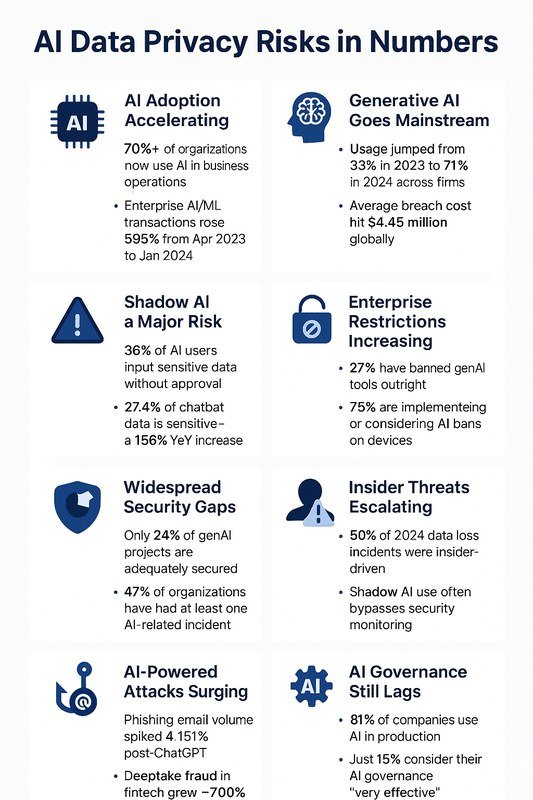
Chatbots are a particular concern because conversations often feel private even when they aren’t. If you’re using a generative AI tool, remember that AI memory in chatbots can persist across sessions, and your inputs may be used to improve the model.
Ignoring Privacy Settings and Updates
Most platforms default to the most permissive settings, and skipping the privacy setup means you’re accepting data collection you never reviewed. Software updates are equally important: they patch security vulnerabilities that can expose your data to attackers. Delaying updates by even a few weeks can leave you vulnerable to known exploits.
Assuming Anonymity Is Guaranteed
Deleting your name from a profile doesn’t make you anonymous. AI can re-identify individuals by combining location patterns, writing style, and social connections. Research has repeatedly shown that “anonymized” datasets can be de-anonymized when combined with other public data.
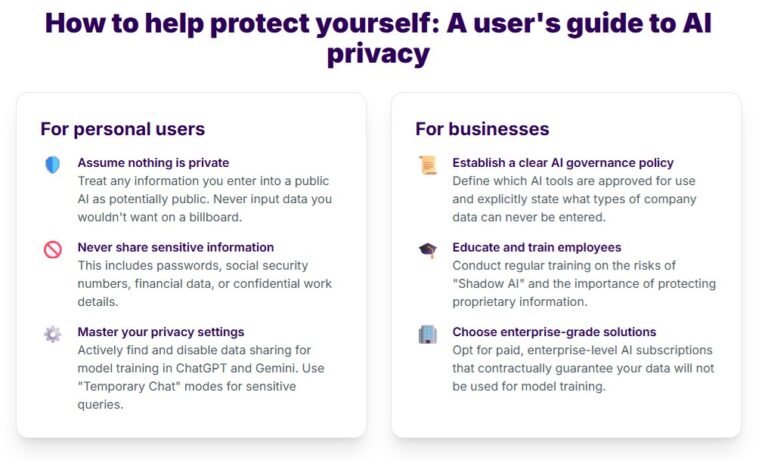
- Review privacy settings on every new app or device before using it.
- Use a password manager and enable two-factor authentication.
- Ask what data is collected and how long it’s kept.
- Sharing sensitive personal details with AI chatbots.
- Assuming a “private” mode makes you invisible to AI tracking.
- Skipping software updates that patch security holes.
Practical Steps to Protect Your Privacy in an AI-Driven World
Adopting a Privacy-First Mindset
Privacy is a habit, not a one-time setup. Start by auditing the apps and services you already use: delete the ones you no longer need, review the permissions you’ve granted, and adjust settings to the most restrictive options that still work for you. Make it a routine to check privacy settings after major app updates, since companies often change their data practices without prominent notice.
Using Privacy-Enhancing Technologies
Several tools can reduce your exposure without requiring you to give up modern conveniences. Privacy-focused browsers block trackers by default, VPNs encrypt your connection to the internet, and encrypted messaging apps protect your conversations from interception. For AI tools specifically, look for options that offer local processing and clear data-deletion policies.
When trying a new AI tool, create a separate email address and avoid linking it to your social media accounts. This simple step limits how much of your existing digital footprint the tool can access.
Advocating for Stronger Regulations
Individual actions have limits. Stronger privacy laws, transparency requirements, and accountability standards for AI systems create a safer environment for everyone. Supporting organizations that advocate for digital rights, contacting your representatives, and staying informed about proposed legislation are all meaningful ways to push for systemic change.
The Value of Understanding AI Privacy Risks and a Final Recommendation
Why This Knowledge Matters Now More Than Ever
AI is no longer a separate “tech” topic—it’s embedded in banking, healthcare, education, and daily communication. The decisions made by AI systems affect your finances, your health care, and your opportunities, often without your awareness. Understanding the privacy trade-offs helps you make informed choices about the tools you use and the information you share.
Final Verdict: Balancing Innovation and Privacy
The goal isn’t to reject AI; it’s to use it with intention. Choose tools that respect your data, minimize what you share, and stay informed about how the systems you rely on actually work. Privacy in the AI era is less about hiding and more about maintaining control over your own information. The most practical approach is simple: treat every AI interaction as a data exchange, and decide whether the value you’re getting is worth the information you’re giving.
Frequently Asked Questions