What is Prompt Engineering in Simple Words Explained
Prompt engineering is the skill of writing clear instructions for AI tools so they produce the response you actually want. It is simple to learn, requires no coding, and makes almost any AI interaction more useful.
Understanding what is prompt engineering in simple words starts with one idea: the instructions you type into an AI tool shape everything that comes back. Prompt engineering is the skill of writing those instructions clearly enough that a chatbot, writing assistant, or image generator gives you the result you actually wanted — instead of a generic response you have to rewrite.
It is not programming, and it does not require a technical background. It is closer to giving clear directions to someone who is eager to help but needs specifics. The more context, structure, and detail you provide, the more useful the AI’s answer becomes. This article explains how prompt engineering works, why it matters now, and how you can start using it today with tools you already have.
- Definition: Prompt engineering is crafting clear instructions for AI tools to get better, more useful.
- Core formula: State the action, add context, specify format and tone, and set limits.
- Who benefits: Writers, students, developers, business owners, and everyday AI users.
- Limitations: A good prompt cannot fix an inaccurate model or replace fact-checking.
- Value: It is a low-cost, high-return skill that takes hours to learn and works immediately.
What Is Prompt Engineering in Simple Words?
Prompt engineering is the practice of designing the text input — the prompt — that you give to an AI system so the system produces a useful, accurate, and well-structured response. A prompt can be a single sentence, a paragraph, or a detailed set of instructions. The “engineering” part simply means being deliberate about how you phrase it.
Think of it this way: if you ask a friend “tell me about cars,” you will get a scattered answer. If you ask “explain the difference between hybrid and electric cars in three bullet points, written for a beginner,” you will get something you can actually use. AI tools like ChatGPT, Claude, Gemini, and Midjourney work the same way. They are powered by generative AI, which means they predict and generate text or images based on the patterns in your request.
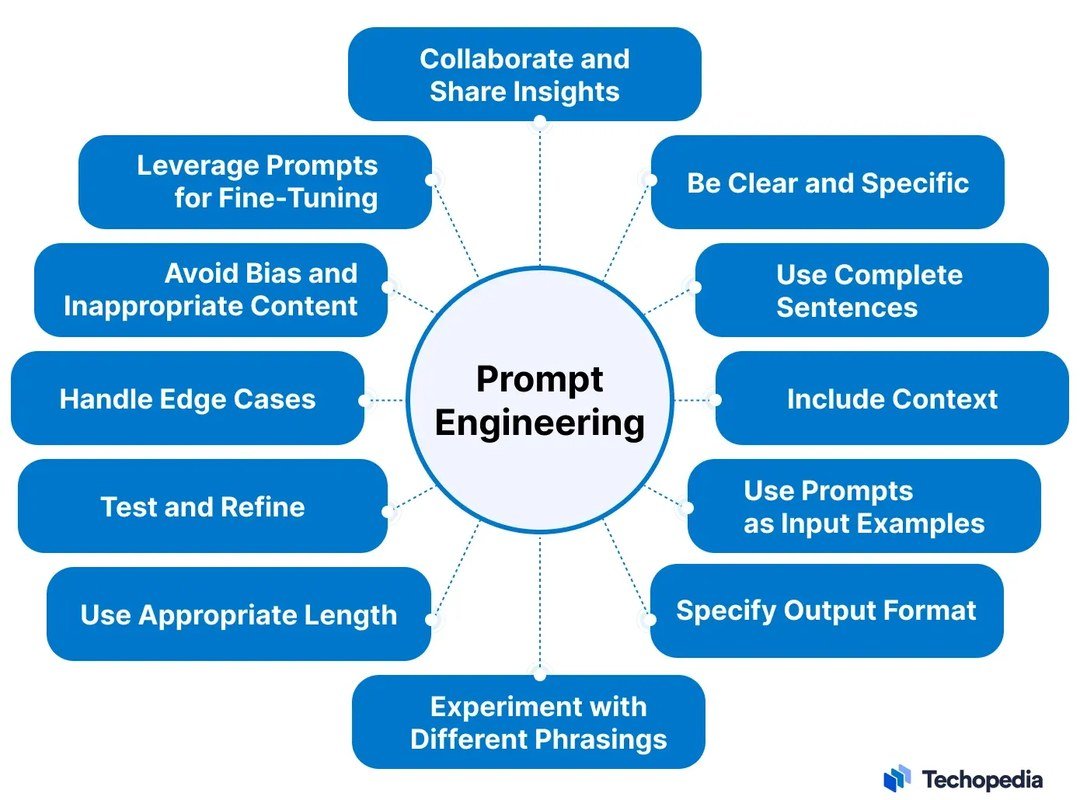
Prompt engineering is the bridge between what you want and what the AI delivers. It is not about tricking the AI or using magic phrases. It is about communicating your intent clearly enough that the model can act on it. The most important idea to remember: a well-written prompt is not longer — it is clearer. Specific instructions beat clever phrasing every time.
Why Prompt Engineering Matters in 2026
User typing a prompt into an AI chat interface, demonstrating prompt engineering in practice.
By 2026, AI tools have moved from novelty to everyday utility. They appear in search engines, email apps, design software, spreadsheets, and customer service chats. Millions of people interact with AI daily, often without realizing it. The quality of those interactions depends on how well the AI understands the request — and that starts with the prompt.
Businesses now use AI to draft marketing copy, summarize reports, write code, and answer customer questions. Students use it to brainstorm and study. Creators use it to generate ideas and edit content. In every case, the gap between a great result and a mediocre one comes down to how the request was framed. This is also why AI automation tools are becoming more popular: companies are building prompts into automated workflows, which means a poorly written prompt can multiply mistakes across hundreds of tasks.
Prompt engineering matters in 2026 because it is one of the few AI-related skills that anyone can learn quickly and use immediately. You do not need a degree in computer science or access to expensive software. You just need to practice writing clear instructions.
The Core Building Blocks of a Well-Written Prompt
Most effective prompts share the same basic structure. Once you understand the parts, you can apply them to almost any AI tool.
Clear Instructions and Context
The first building block is telling the AI exactly what you want it to do. “Write a summary” is weak. “Summarize this 500-word article in five sentences, focusing on the main arguments and leaving out examples” is strong. The instruction should state the action, the subject, and the level of detail.
Context is the second half of this block. The AI does not know who you are, who your audience is, or why you need the information unless you tell it. Adding one or two sentences of background can transform a generic answer into a tailored one. For example:
Weak prompt: “Give me ideas for a birthday party.”
Strong prompt: “Give me five birthday party themes for a 7-year-old who loves dinosaurs. Each theme should include a simple decoration idea, one game, and a cake suggestion. Keep it practical for a small apartment.”
When you are unsure how much context to give, start with more than you think you need. You can always ask the AI to shorten or simplify its answer, but it cannot guess information you never provided.
Format, Tone, and Constraints
The second building block is telling the AI how to present the answer. Format means the structure: a bullet list, a table, a step-by-step guide, an email, a headline, or a paragraph. Tone means the attitude: professional, casual, friendly, persuasive, or neutral. Constraints are the limits: word count, reading level, length, or things to avoid.
Here is the same request with and without these details:
Without: “Write a product description for a coffee mug.”
With: “Write a 50-word product description for a ceramic coffee mug. Use a warm, friendly tone. Mention that it is dishwasher-safe and holds 12 ounces. Format it as a short paragraph for an online store.”
The second version gives the AI everything it needs to produce a usable answer on the first try. This is the core of prompt engineering: reducing guesswork on the AI’s side.
Who Should Learn Prompt Engineering?<

Professionals from various fields attend a prompt engineering workshop.
Professionals from various fields attend a prompt engineering workshop.
Almost anyone who uses AI tools can benefit from learning prompt engineering. The skill is especially valuable for:
Writers and marketers who use AI to draft headlines, social posts, emails, or blog outlines. A clear prompt saves editing time and produces copy that sounds less generic.
Students and educators who use AI for research, summaries, or study guides. Knowing how to ask for explanations at the right level makes the tool a better tutor.
Developers and data professionals who use AI to generate code, debug errors, or explain technical concepts. Precise prompts reduce back-and-forth and improve code quality.
Small business owners who use AI for customer replies, product descriptions, or simple reports. They often do not have time to rewrite long outputs, so getting it right the first time matters.
Everyday users who just want better answers from their favorite AI app. You do not need a job title to benefit from asking clearer questions.
Prompt engineering is also a useful foundation for understanding more advanced AI concepts, such as AI agents, which use prompts as part of larger automated tasks. The more comfortable you are with writing instructions, the easier it is to understand how these systems behave.
Simple Prompt Engineering Examples Anyone Can Use
Here are three before-and-after examples that show the difference prompt engineering makes in everyday situations.
| Scenario | Weak Prompt | Strong Prompt |
|---|---|---|
| Email to a client | “Write an email about a delay.” | “Write a polite email to a client explaining that their order is delayed by one week due to a shipping issue. Apologize, offer free shipping on their next order, and end with a question about whether they want to proceed. Keep it under 120 words.” |
| Study guide | “Explain photosynthesis.” | “Explain photosynthesis in four steps for a 10th-grade biology student. Use simple language, include one analogy, and list the key terms at the end.” |
| Dinner planning | “Give me a healthy meal plan.” | “Create a 3-day meal plan for one person who wants high-protein, vegetarian dinners. Each day should include a main dish and a side, with total prep time under 40 minutes. Present it as a table.” |
Notice that the strong prompts do not use fancy vocabulary or special commands. They simply state the task, the audience, the format, and the limits. That is all prompt engineering is in practice.
Begin with a clear verb: write, summarize, compare, list, explain, or create.
Say exactly what topic you mean and why you need it.
Tell the AI whether you want a list, table, email, paragraph, or outline, and how it should sound.
Add word count, reading level, or anything the AI should avoid.
Common Prompt Engineering Mistakes to Avoid
Even people who understand the basics make these mistakes. Here is what to watch out for.
- Break one big request into smaller, focused prompts.
- Tell the AI who the answer is for and how it will be used.
- Ask for a specific format so the output is ready to use.
- Follow up with corrections like “shorter” or “more formal” instead of starting over.
- Avoid vague requests like “write something about marketing.”
- Avoid cramming multiple unrelated tasks into one prompt.
- Avoid assuming the AI remembers earlier conversations unless the tool states otherwise.
- Avoid trusting the output without checking the facts.
One of the most common mistakes is treating the AI like a search engine. A search query like “best laptops 2026” is fine for search, but a prompt like “compare the best laptops under $1,000 for a college student who needs long battery life, and present it as a table” gives the AI a much better chance of producing something useful.
The Real Limitations of Prompt Engineering
Prompt engineering is a useful skill, but it is not magic. It is important to understand what it cannot do.
First, a great prompt cannot fix a weak model. If the underlying AI has outdated information or limited reasoning ability, no amount of clever phrasing will make it accurate. Every model has boundaries, and prompt engineering works within them.
Second, AI models can still produce confident-sounding but incorrect answers — often called hallucinations. A well-structured prompt reduces the risk, but it does not eliminate it. You still need to verify important facts, especially for medical, legal, financial, or technical decisions.
Third, prompt engineering is not a substitute for domain expertise. If you do not know what a good answer looks like, you will not be able to judge the AI’s response. The skill amplifies your existing knowledge; it does not replace it. Prompting is also an iterative process. The first response is rarely perfect, so treat it as a draft and refine it with follow-up instructions like “make it shorter,” “add examples,” or “change the tone.”
Finally, prompts do not always transfer between tools. A prompt that works well in one chatbot may produce different results in another because each model is trained differently. The principles stay the same, but you will need to adjust and test.
Is Learning Prompt Engineering Worth It?
For most people, yes. Prompt engineering is a low-cost skill with immediate practical benefits. It takes a few hours to learn the basics and a few weeks of practice to become genuinely good. You do not need to buy anything, and you can practice with free AI tools.
The skill is especially valuable as AI becomes a standard part of work and daily life. In fact, AI is changing jobs across nearly every industry, and the people who adapt best are often those who can communicate clearly with AI systems. Being able to get a useful answer on the first try saves time, reduces frustration, and produces better work.
However, it is also worth being honest about the limits. Prompt engineering is not a guaranteed career path on its own, and it is not a substitute for real expertise in your field. It is a complementary skill — one that makes you more effective at whatever you already do.
- Quick to learn and practice with free tools
- Improves the quality of AI output immediately
- Useful across writing, coding, study, and work tasks
- Requires no technical background
- Cannot fix inaccurate or outdated AI models
- Prompts may need adjustment between different tools
- Does not replace real expertise or fact-checking
- Prompt engineering is the skill of writing clear instructions for AI tools to get better responses.
- The core formula is simple: state the action, add context, specify the format and tone, and set limits.
- Anyone who uses AI can benefit, and it takes only a few hours to learn the basics.
- The main limitations are model accuracy, hallucinations, and the need for domain knowledge to judge results.
- If you already use AI regularly, learning to write better prompts is one of the highest-value skills you can pick up.
Frequently Asked Questions