What Is Agentic AI and Why It Matters for Your Business
Agentic AI is a class of AI systems that pursue a goal across multiple steps, using planning, memory, and external tools to take action with limited human input. It matters because it moves AI from suggesting answers to completing real work, which can change how businesses operate.
If you have been looking for a clear explanation of what is agentic ai and why it matters for your business, this guide is for you. Agentic AI marks a shift from tools that suggest answers to systems that can take action on your behalf, and that difference is worth understanding before you invest in another AI platform.
In simple terms, agentic AI is software designed to pursue a goal across multiple steps. Instead of waiting for a prompt every time, an agent can break down a task, decide what to do next, use tools like databases or email, and keep working until the job is done—or until it needs human input. This article explains how it works, what it can do for your business, where it falls short, and how to adopt it responsibly.
- Definition: Agentic AI plans, remembers context, and uses tools to complete multi-step tasks autonomously.
- Difference: Unlike chatbots and generative AI, agentic AI acts on goals rather than just generating.
- Business value: It can reduce repetitive work, improve consistency, and operate 24/7 across finance, service, supply.
- Key risk: Hallucination, oversight gaps, and over-automation require human checkpoints and strong governance.
- First step: Start with a narrow, low-risk process, measure outcomes, and expand only after controls are.
What Is Agentic AI? A Clear Definition for Business Leaders
Agentic AI refers to AI systems that can plan, reason, and execute multi-step tasks with limited human supervision. The word “agentic” comes from “agent”—an entity that acts in an environment to achieve a goal. In a business context, an agentic AI system might receive a high-level instruction like “reconcile yesterday’s invoices” and then handle the steps: pulling data, checking matches, flagging exceptions, and sending a summary.
This is different from a single model that just predicts the next word or image. Agentic AI typically combines a large language model with additional layers: memory, planning tools, external APIs, and feedback loops. The result is a system that can navigate real-world workflows, not just generate content.
Agentic AI vs. Generative AI vs. Chatbots: Key Differences
Chatbots, generative AI, and agentic AI are often lumped together, but they serve different purposes. A chatbot responds to user input with text or basic actions. It is reactive: you ask, it answers. Generative AI creates new content—text, images, code, or audio—based on patterns in training data. It is powerful, but it usually stops after producing an output.
Agentic AI goes further. It sets a goal, creates a plan, executes steps, evaluates results, and adjusts. For example, a generative AI tool can draft a customer refund email. An agentic AI system can detect a late shipment, check the refund policy, draft the email, send it through the CRM, and log the outcome. The difference is autonomy: the agent decides what actions are needed to reach the goal.
How Agentic AI Works: Planning, Memory, and Tool Use
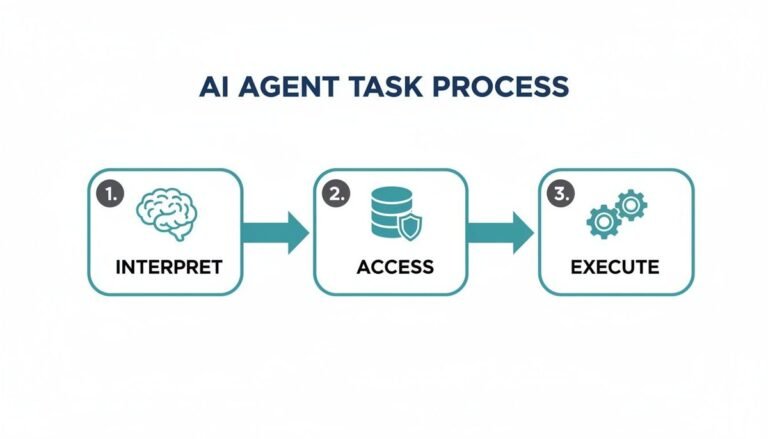
Three components make agentic AI work in practice:
- Planning: The agent breaks a goal into smaller sub-tasks, prioritizes them, and chooses the best sequence. This can be as simple as a to-do list or as complex as a dynamic decision tree.
- Memory: The agent remembers what it has already done, what worked, and what information it has gathered. Memory can be short-term within a single task or long-term across sessions, which lets it learn from past interactions.
- Tool use: The agent calls external tools—APIs, databases, spreadsheets, web search, or internal software—to get data and take actions. Without tool use, an agent is just a very smart talker.
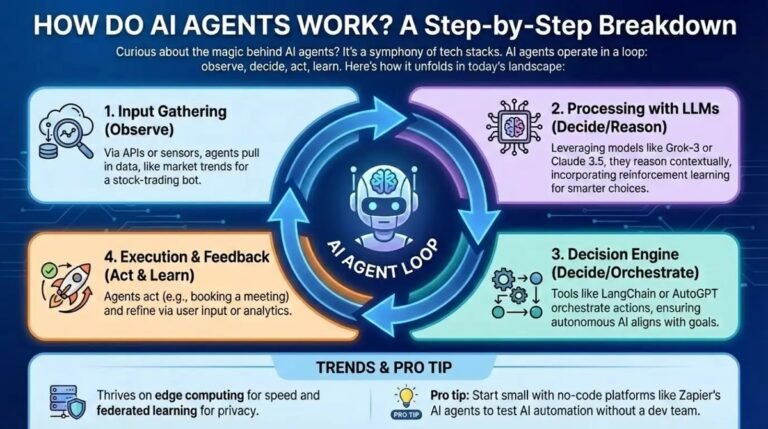
For a deeper look at the mechanics, read our step-by-step guide on how AI agents work step by step.
Agentic AI is not one single model. It is a pattern that combines language understanding, planning logic, memory storage, and integrations with other software. The same core model can power many different agents, each designed for a specific business workflow.
Why Agentic AI Matters: The Shift from Automation to Autonomy

Diagram illustrating the shift from rule-based automation to autonomous AI agents.
As of 2026, businesses are moving beyond chatbots and copilots toward agents that can complete real work. The difference matters because the stakes are higher: an agent doesn’t just recommend a decision; it executes one. That shift from automation to autonomy changes how work gets done, who oversees it, and what tools you need.
Moving Beyond Rule-Based Workflows
Traditional AI automation follows fixed rules: if this happens, do that. It works well for stable, predictable processes like sending a confirmation email after an order. But it breaks down when conditions change, exceptions appear, or the task requires judgment.
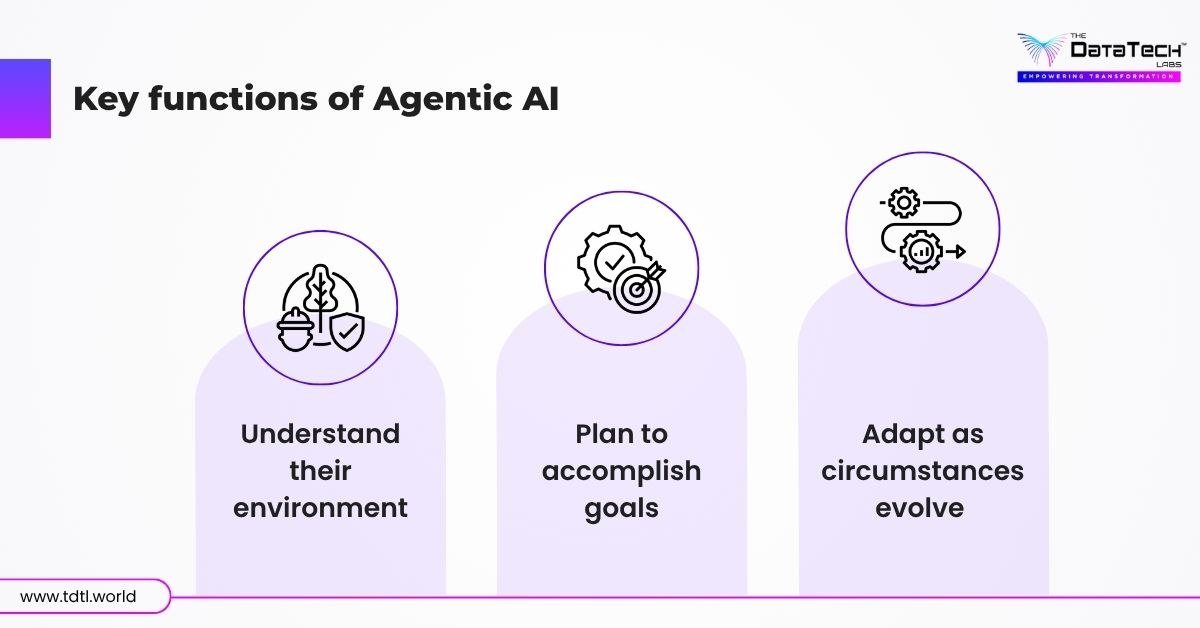
Agentic AI handles ambiguity better. It can interpret a vague request, gather missing information, choose among multiple actions, and change course when an approach fails. This makes it useful for work that previously required a human to juggle several systems and make judgment calls.
What Agentic AI Unlocks for Daily Business Operations
For many teams, agentic AI acts like a reliable junior colleague who never sleeps. It can monitor an inbox, triage requests, update records, schedule follow-ups, and escalate only when needed. It can also coordinate across departments: an agent in finance can pull data from sales, validate it against contracts, and prepare a report without a human copying files between systems.
The practical result is that routine, time-consuming work shrinks from hours to minutes. Employees spend less time on data entry and status checks and more time on judgment-heavy work like strategy, relationship building, and creative problem-solving.
Key Capabilities and Specifications to Look For
Not all “agentic AI” products are equal. When evaluating platforms, look beyond marketing language and check whether the system actually has the core capabilities described below. The exact specifications vary by vendor and model, so use these criteria as your checklist rather than assuming every product includes everything.
Core Technical Components: Reasoning, Goal Decomposition, and Self-Correction
Three technical abilities separate a genuine agent from an automated script:
- Reasoning: The system can weigh options, infer implications, and choose a sensible next step based on context. This is usually powered by a large language model, but it must be grounded in real data.
- Goal decomposition: The agent can take a broad objective like “prepare monthly sales report” and break it into concrete sub-tasks: query CRM, calculate totals, compare with targets, generate charts, draft summary.
- Self-correction: When a step fails or an output looks wrong, the agent can detect the problem, try another approach, or ask for help. Self-correction is critical for reducing errors in long workflows.
Integration Requirements: APIs, Data Access, and Security Protocols
An agent is only as useful as the tools it can reach. Look for platforms that offer robust APIs, pre-built connectors for common business software, and clear data-access controls. You should be able to define exactly what data an agent can read, write, or delete—and revoke access when needed.
Security matters more with agents because they take actions, not just read data. A compromised agent could send emails, change records, or trigger payments. Ensure the platform supports audit logs, role-based permissions, encryption in transit and at rest, and human approval checkpoints for high-risk actions.
Agentic AI capabilities vary significantly by vendor, model version, and integration depth. Always confirm current feature lists, API limits, data retention policies, and security certifications with the vendor before committing to a platform.
Which Businesses and Departments Benefit Most<

Infographic ranking departments by agentic AI benefit, led by customer service and IT.
Infographic ranking departments by agentic AI benefit, led by customer service and IT.
Agentic AI is not a one-size-fits-all solution. Some industries and departments will see faster, clearer returns because their workflows are more structured and data-rich. Others, especially highly creative or heavily regulated fields, may need more careful implementation.
Best Industry Fits: Finance, Customer Service, Supply Chain, and IT
Four areas tend to benefit most:
- Finance: Invoice processing, expense validation, reconciliation, and fraud flagging involve clear rules and repeated data checks. Agents can reduce manual review time and catch inconsistencies faster.
- Customer service: Agents can handle routine inquiries, escalate complex issues, update customer records, and follow up after resolution, providing faster responses outside business hours.
- Supply chain: Inventory monitoring, purchase order matching, shipment tracking, and exception handling are well-suited to agents that can pull data from multiple systems and act on it.
- IT: Ticket triage, password resets, access requests, and system monitoring are repetitive, rule-based tasks that agents can manage while humans handle complex incidents.
High-Impact Use Cases: From Inbox Management to Complex Research
Even outside those departments, agentic AI can add value in everyday work. Common high-impact use cases include:
- Inbox management: Sorting emails, drafting responses, scheduling meetings, and flagging urgent messages.
- Research and analysis: Gathering information from multiple sources, summarizing findings, comparing options, and preparing briefing documents.
- Report generation: Pulling numbers from internal tools, creating charts, writing narrative summaries, and distributing reports to stakeholders.
- Employee onboarding: Collecting forms, setting up accounts, answering policy questions, and sending reminders.
These use cases reflect a broader trend of how AI is changing everyday life—not just for consumers, but for the way work gets done inside organizations.
Benefits of Adopting Agentic AI
The business case for agentic AI usually comes down to three things: doing more with less, doing it consistently, and doing it around the clock. But the benefits are not automatic; they depend on choosing the right processes and setting up proper oversight.
Efficiency Gains, Cost Reduction,and 24/7 Availability
Because agents can work continuously, they remove bottlenecks caused by business hours, time zones, and human fatigue. A customer request logged at midnight can be triaged by dawn. An invoice discrepancy can be flagged before the finance team starts work. Over time, this reduces labor hours spent on routine tasks and can lower operating costs—though the savings are partly offset by platform fees, integration work, and governance overhead.
Scalability and Consistency Across Repetitive Tasks
Human teams struggle to apply the same rules every time, especially under pressure. Agents follow defined policies consistently, which improves compliance and reduces variability. They also scale easily: adding another agent or expanding to a new workflow often costs less than hiring and training additional staff. That consistency makes agentic AI attractive for quality control, audit readiness, and standardized service delivery.
- Handles multi-step tasks without constant human input
- Works 24/7 across time zones
- Applies rules consistently and reduces manual errors
- Scales to higher volumes without proportional headcount growth
- Can produce confident but wrong outputs if data or instructions are poor
- Needs careful integration, security controls, and monitoring
- May require significant setup and ongoing maintenance
- Not suitable for every task, especially high-judgment or highly creative work
Limitations and Common Mistakes to Avoid
Agentic AI is powerful, but it is not magic. Understanding its limits before deployment will save you from costly surprises. The most common failures fall into two categories: problems with the AI itself and problems with how the system is implemented.
Hallucination Risks, Oversight Gaps,and Control Challenges
Like other large language models, agentic AI can hallucinate—produce plausible-sounding but incorrect information. In an agentic system, a hallucinated fact can lead to a wrong action, such as sending an incorrect refund or flagging a valid invoice as fraud. That risk grows when the agent has access to actions, not just text generation.
Oversight gaps happen when organizations give agents too much autonomy too quickly. Without clear approval workflows, audit trails, or limits on what the agent can change, a small error can cascade into a bigger problem. Control challenges also arise when agents interact with multiple systems: it becomes harder to trace which action caused which outcome.
Treat agentic AI outputs as drafts, not final decisions—especially in regulated industries like healthcare, finance, or legal. Always keep a human in the loop for high-stakes actions, and define what happens when an agent is uncertain.
Implementation Pitfalls: Over-Automation and Poor Data Quality
Over-automation occurs when a business automates a process that still needs human judgment, empathy, or context. For example, an agent might handle a customer complaint efficiently but miss the emotional nuance that requires a human apology. The result is faster service but worse customer relationships.
Poor data quality is another common trap. An agent trained on messy, incomplete, or biased data will make messy decisions. If your source systems have duplicate records, outdated prices, or inconsistent categories, fix those problems before deploying an agent—otherwise you will simply automate your existing errors at higher speed.
- Start with low-risk, well-defined tasks with clear success metrics
- Require human approval for actions that cost money, delete data, or communicate externally
- Log every agent action so you can audit what happened and why
- Test with real historical cases to see how the agent handles exceptions
- Avoid giving agents broad access to sensitive systems without strict permissions
- Avoid automating processes that are still changing or poorly documented
- Avoid assuming the agent understands company policy without explicit instructions
- Avoid skipping regular reviews of agent behavior and performance
Governance, Maintenance,and Ongoing Care for Agentic Systems
Deploying an agentic AI system is not a set-and-forget project. It requires the same discipline as managing a new employee: training, supervision, feedback, and periodic reviews. Organizations that treat agents as permanent infrastructure tend to get better results and fewer incidents.
Monitoring, Logging,and Updating Agent Behavior
Every action an agent takes should be logged: what input it received, what decision it made, which tools it called, and what outcome occurred. Logging helps you debug failures, spot patterns, and prove compliance. Monitoring goes further—you should track success rates, error rates, average task completion time, and how often the agent asks for help.
Agents also need updates. As your business processes, policies, and data change, the agent’s instructions, prompts, and tool integrations must be refreshed. Schedule regular reviews—monthly or quarterly—to check whether the agent is still aligned with current rules and whether new capabilities should be added.
Building a Responsible AI Framework: Human Oversightand Compliance
A responsible AI framework defines who owns the agent, what it is allowed to do, and how it is held accountable. Start by assigning a human owner for each agent. That person reviews exceptions, approves high-risk actions, and decides when to retire or retrain the agent.
Compliance is another layer. Depending on your industry, you may need to document how decisions are made, ensure data privacy, and provide explanations for automated actions. Build these requirements into the design from the start rather than trying to retrofit them after a problem occurs.
- Identify a specific process with clear rules and measurable outcomes
- Define data access limits and human approval checkpoints
- Set up logging and monitoring from day one
- Create a rollback plan in case the agent misbehaves
- Assign a human owner responsible for oversight and updates
Final Recommendation: Is Agentic AI Worth It for Your Business?
For most organizations, agentic AI is worth exploring—but not by deploying it everywhere at once. The value is real for repetitive, multi-step, data-heavy work. The risk is manageable when you keep humans in the loop, start small, and build governance alongside the technology.
Evaluating Readiness, Costs,and Long-Term Value
Before investing, assess your readiness honestly. Do you have clean, accessible data? Can your existing software systems support API integrations? Do you have staff who can monitor agents and handle exceptions? If the answer is no, invest in those foundations first.
Costs vary widely by vendor, usage volume, number of agents, and integration complexity. Some platforms charge per task or per active agent, while enterprise deployments require custom pricing. Confirm current pricing with vendors and calculate total cost of ownership, including integration, training, monitoring, and maintenance. Long-term value comes from compounding efficiency: a well-designed agent can free up hundreds of hours per year, but a poorly designed one can create new problems.
Getting Started: A Practical First Step
Start with one narrow, low-risk process. Good candidates include internal ticket triage, expense report validation, email classification, or meeting scheduling. Choose a task where mistakes are easy to catch and undo, where the rules are clear, and where you can measure before-and-after performance.
Run a pilot with a small group, monitor every action, and compare results against your baseline. Once the agent consistently meets your standards, expand gradually to adjacent workflows. This approach lets you build confidence, refine governance, and demonstrate value before scaling.
Choose a pilot process that is annoying enough to matter but simple enough to succeed. A good test is one where a human can complete the task in five to fifteen minutes, because it gives you a clear baseline and makes errors easy to spot.
- Agentic AI plans, remembers, uses tools, and self-corrects to complete multi-step tasks with limited supervision.
- It differs from chatbots and generative AI by taking action rather than just generating responses.
- Finance, customer service, supply chain, and IT offer the clearest early opportunities.
- Manage risks with human oversight, logging, data quality controls, and a narrow pilot before scaling.
- Start small, measure results, and expand only after governance and performance are proven.
Frequently Asked Questions