What Is Artificial General Intelligence Explained Simply
Artificial general intelligence (AGI) is a hypothetical AI system that can learn, reason, and adapt across a wide range of tasks at a level comparable to a human. Today’s AI tools are narrow, so AGI remains an ambitious research goal rather than a current product.
Before we define what is artificial general intelligence, it helps to look at how today’s AI actually works. Most of the AI you interact with — search engines, chatbots, and recommendation systems — is narrow. It performs one task well and struggles outside its lane. AGI is a different idea: a single system that can reason, learn, and adapt across many different kinds of tasks the way a person can. This article explains what AGI is, what it isn’t, and why the debate around it matters.
- Definition: AGI would match human-level flexibility across many tasks, unlike narrow AI.
- Key difference: AGI is not the same as superintelligence, which would exceed human ability in every.
- Core capabilities: Reasoning, learning, adaptation, and common sense are essential to AGI.
- Current status: Major technical hurdles remain, and no one knows when AGI will arrive.
- Risks: Alignment and safety are unsolved problems, not science-fiction side notes.
What Is Artificial General Intelligence?
Artificial general intelligence (AGI) is a term used for a machine that can understand, learn, and apply knowledge across a broad range of tasks at a level equal to or better than a human being. Unlike today’s specialized AI, an AGI system would not need to be retrained for every new job. It could read a medical study, reason about a legal case, write a recipe, and learn to drive a car — all with the same flexible intelligence.
AGI vs. Narrow AI: The Core Difference
Most AI today is narrow. A spam filter knows email, a chess engine knows chess, and a language model knows patterns in text. Narrow AI can outperform humans in its specific domain, but it cannot transfer that skill to something new. AGI would be general: the same system could handle unfamiliar situations and learn new skills without starting from scratch. If you’re new to the basics, our guide to what artificial intelligence is in simple words explains how these systems fit together.
AGI is not a product you can buy or install today. When a company calls its tool “AGI,” check whether it can handle many unrelated tasks or just one type of task very well.
AGI vs. Superintelligence: A Crucial Distinction
People often use AGI and superintelligence as if they mean the same thing. They don’t. AGI matches human-level ability across a wide range of tasks. Superintelligence goes beyond that: it is a system that is smarter than the best human experts in virtually every field, including scientific creativity and social judgment. AGI is a milestone; superintelligence is a much bigger and more speculative step beyond it.
| Concept | Scope | Example |
|---|---|---|
| Narrow AI | One specific task | Spam filter, image recognizer |
| AGI | Human-level breadth | Learning and reasoning across many jobs |
| Superintelligence | Beyond human ability | Outperforming all experts in every field |
Key Capabilities That Define AGI
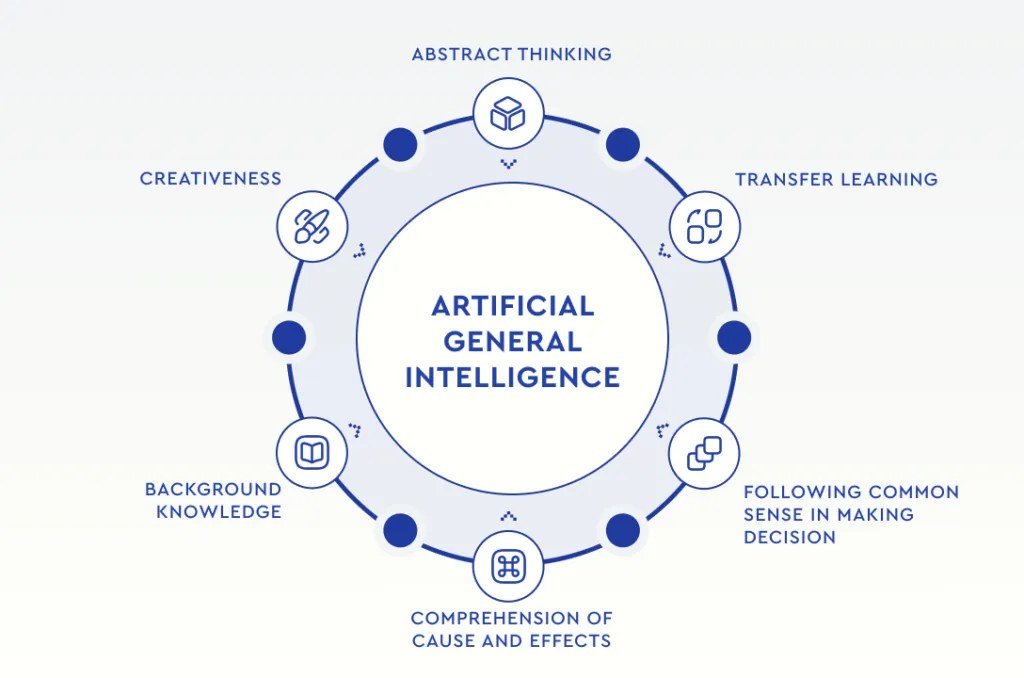
A diagram showing the core capabilities that define artificial general intelligence.
To count as AGI, a system would need more than raw processing power. Researchers generally point to a few core abilities that separate a general intelligence from a clever tool.
Reasoning, Learning, and Adapting Across Domains
An AGI system would need to reason through problems it has never seen, learn from limited experience, and adapt what it knows to new contexts. That means transferring knowledge: understanding that cause and effect work the same way in a physics experiment and a business negotiation. Today’s models can mimic reasoning in familiar situations, but they often fail when the pattern changes.
Common Sense and Contextual Understanding
Human intelligence depends on common sense — knowing that a cup can spill, that people can be tired, or that a question may have an unspoken context. AGI would need this kind of world knowledge to interact safely and usefully. Current AI can sound confident while missing obvious context, which is why common sense remains one of the hardest parts of the problem.
The Technical Building Blocks Behind AGI
Researchers are exploring several approaches that could eventually lead to AGI. None of them is a finished formula, but each adds a piece of the puzzle.
Neural Networks, Reinforcement Learning, and World Models
Neural networks are the foundation of modern AI. They learn patterns from data, which is why deep learning powers many of today’s systems. Reinforcement learning adds trial and error: an agent takes actions, receives feedback, and improves its strategy. World models go a step further by giving the system a mental simulation of how the environment works, so it can plan ahead instead of just reacting.
The Turing test, proposed in 1950, was one of the earliest attempts to define machine intelligence. It asks whether a machine can converse so naturally that a human cannot tell it apart from a person.
The Missing Pieces: Architecture, Energy, and Data
Even with these tools, AGI remains out of reach. Today’s systems need enormous amounts of data and computing power, and they still lack the ability to learn continuously without forgetting old skills. Researchers also disagree on what architecture could combine all the pieces. Energy efficiency is another barrier: the human brain uses far less energy than a data center, yet it handles a much wider range of tasks.
Where AGI Would Fit: Applications and Impact<
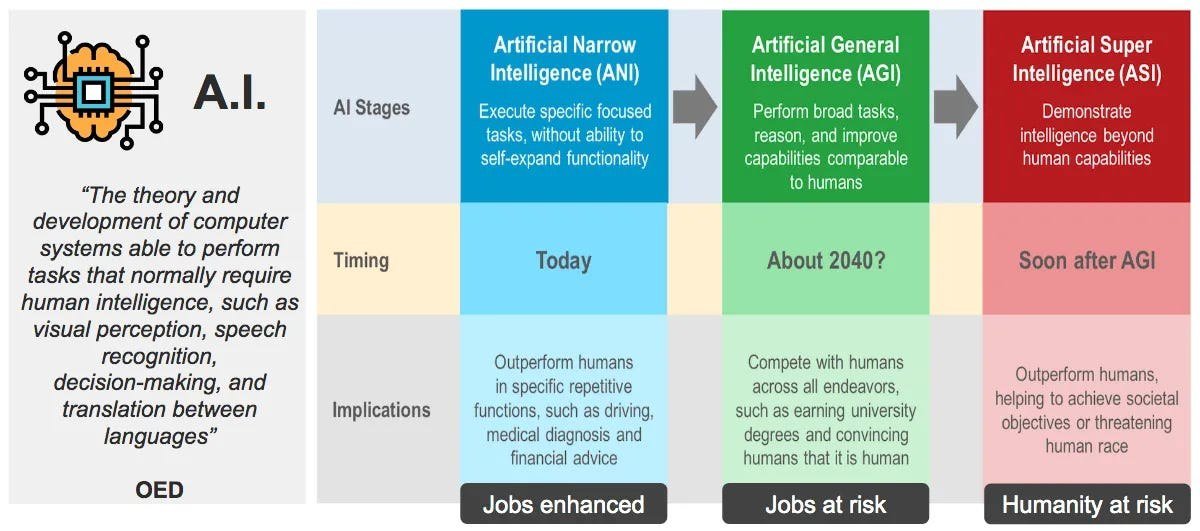
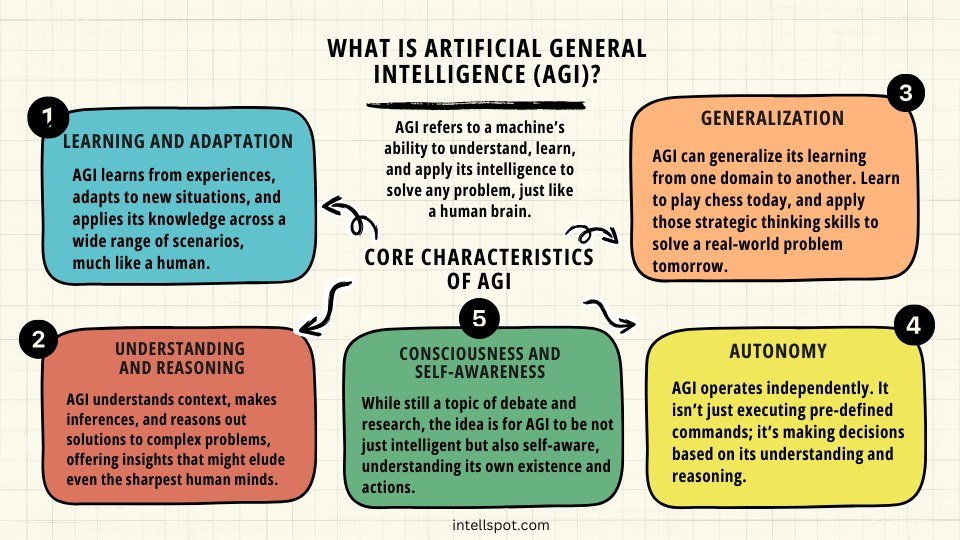
Diagram showing where AGI fits among AI types, with applications and impact examples.
Diagram showing where AGI fits among AI types, with applications and impact examples.
Because AGI would be general, its applications would touch almost every field. The impact would depend on how quickly it arrives and how it is controlled.
Healthcare and Scientific Discovery
An AGI system could read medical research, analyze patient data, and help doctors design personalized treatments. It could also run virtual experiments, spot patterns in complex biological data, and suggest new materials or drugs. Today’s narrow AI already helps with some of these tasks, but AGI could connect the dots across disciplines in a way no single tool can.
Business, Education, and Everyday Life
In business, AGI could handle analysis, planning, and customer interaction without constant human supervision. In education, it could act as a tutor that adapts to each student’s pace. At home, it could manage schedules, answer complex questions, and help with creative projects. That vision is a long way from today’s tools, but it explains why people are watching the field so closely. To see how current AI already fits into daily routines, our overview of how AI is changing everyday life is a useful starting point.
The Benefits of AGI: Why It Matters
AGI is often discussed as a risk, but the potential benefits are enormous. The same flexibility that makes it hard to build would make it useful.
Tackling Global Challenges at Scale
Climate modeling, disease prevention, food distribution, and energy planning all involve huge amounts of data and many interacting variables. An AGI that could reason across these systems might help scientists find solutions faster than teams of specialists working separately. It would not replace human judgment, but it could act as a powerful analytical partner.
Amplifying Human Creativity and Productivity
AGI could handle the repetitive parts of work — drafting, summarizing, coding, and scheduling — and leave people more time for original thinking. It could also serve as a creative collaborator, generating ideas for a designer, a writer, or an engineer to refine. The goal is not to remove humans from the loop but to make the loop faster and broader.
The Limitations and Risks of AGI
AGI is not just a bigger version of today’s AI. It raises problems that current systems do not have.
Unsolved Technical Hurdles
Building AGI requires solving the flexibility problem: a system that can learn new tasks quickly, remember old ones, and make reliable judgments in unfamiliar situations. Today’s models are brittle. They can be impressive in one setting and fail in another. Researchers also do not fully understand how their models arrive at decisions, which makes trust harder.
Alignment, Safety, and Ethical Concerns
Even a well-intentioned AGI could cause harm if its goals do not match human values. Alignment is the challenge of making sure an AGI does what people actually want, in all the messy contexts of real life. There are also concerns about job displacement, concentration of power, and misuse. These are not science-fiction worries; they are active areas of research in AI safety.
Common Misconceptions About AGI
Because AGI is such a big idea, it attracts a lot of confusion. A few misconceptions come up again and again.
“AGI Is Just a Smarter Chatbot”
Chatbots and language models can hold conversations, write essays, and answer questions, but they do not understand the world the way people do. They predict text patterns, and they have no persistent goals, memory, or real-world experience. Calling a chatbot AGI is like calling a calculator a mathematician.
“AGI Is Right Around the Corner”
Some headlines claim AGI is only a few years away. Others say it will never happen. The honest answer is that no one knows. Many experts point to major unsolved problems in reasoning, memory, and common sense, while others believe rapid progress could surprise us. Treat confident timelines with skepticism.
How to Prepare for an AGI Future
The best way to prepare is to stay informed without being swept up in hype. Follow reliable sources, learn how AI systems actually work, and watch for concrete milestones rather than vague promises. If you understand the difference between narrow AI and AGI, you will be less likely to fall for misleading claims.
When reading AI news, separate three things: what a system can do today, what its developers claim it may do soon, and what would be required to make that leap. Most confusion comes from mixing those three.
Reading the Timeline Realistically
No single milestone marks the arrival of AGI. Progress will likely be gradual, with systems that are more general than today’s tools but still far from human-like. Watch for advances in reasoning, memory, and continuous learning — those are the areas that matter most.
A Practical Final Takeaway
AGI is a research goal, not a current product. It promises machines that can think broadly, but it also brings serious technical and ethical challenges. For now, the most practical step is to learn how today’s AI works, build digital skills, and keep an eye on the field as it evolves. The future may be uncertain, but the need for informed judgment is not.
- AGI means human-level flexibility across many tasks, unlike narrow AI.
- Key capabilities include reasoning, learning, common sense, and adaptation.
- Technical hurdles remain in architecture, energy, and data.
- Benefits are large, but alignment and safety are unsolved concerns.
- Treat confident timelines with caution and keep learning.
Frequently Asked Questions